
Best time to visit Norway: fjords and northern lights
In short
The best time to visit Norway's fjords is June to August: Oslo then reaches 20 to 22 °C by day and Bergen 17 °C, with very long days. In Tromsø the midnight sun lasts from 20 May to 22 July. For northern lights, go from late September to March, when the nights are dark; Tromsø then averages around -4 to 0 °C by day in midwinter. Bergen is wet all year, with 110 to 300 mm a month.
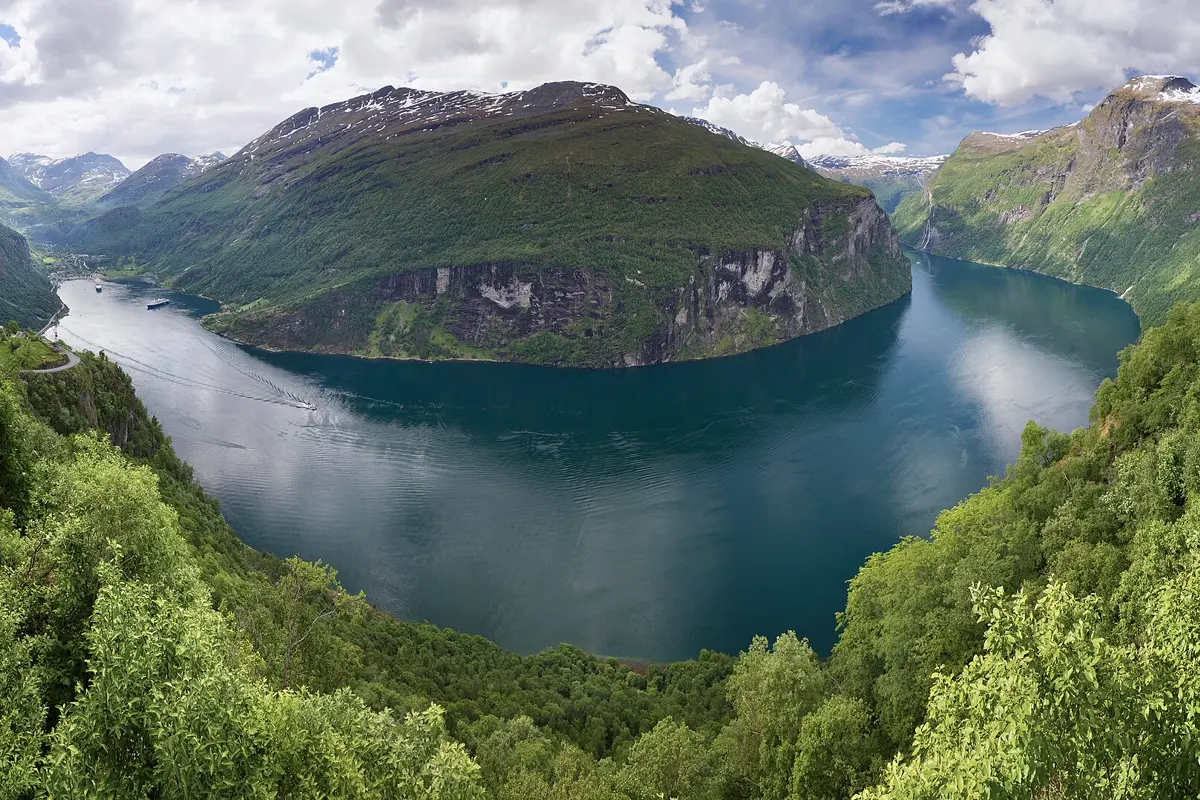
Norway stretches about 1,700 km from the south coast to the North Cape, and a large part of it lies north of the Arctic Circle. That makes the "best time" depend on what you want: the fjords and mountain roads in summer, the midnight sun in the far north around midsummer, or the northern lights in the dark winter months. The coast is milder than its latitude suggests but very wet, while the east around Oslo has warmer summers and colder winters. We analysed the weather from 2015 to 2024 at three places: Oslo, Bergen and Tromsø.
The short answer
- Best time for the fjords and a road trip: June to August. Oslo averages 20 to 22 °C by day and Bergen around 17 °C, with long, light evenings.
- Midnight sun: in Tromsø from 20 May to 22 July, according to Visit Norway.
- Northern lights: late September to March, when the nights are dark. Around Tromsø the polar night lasts from late November to mid-January.
- Shoulder season: May and September – quieter, with cooler weather; some mountain roads may still be closed in May.
- Wettest place: Bergen, with 108 to 295 mm a month and over 250 mm from August to February.
Norway's climate: all 12 months
| Month | Oslo day | Oslo night | Oslo rain | Bergen day | Bergen rain | Tromsø day | Tromsø night |
|---|---|---|---|---|---|---|---|
| January | 0.0 °C | -5.5 °C | 73 mm | 2.8 °C | 264 mm | -3.9 °C | -8.6 °C |
| February | 1.7 °C | -4.3 °C | 60 mm | 3.7 °C | 233 mm | -2.6 °C | -7.3 °C |
| March | 5.3 °C | -2.4 °C | 58 mm | 5.8 °C | 182 mm | -0.7 °C | -5.7 °C |
| April | 10.8 °C | 1.4 °C | 50 mm | 9.3 °C | 108 mm | 2.8 °C | -2.7 °C |
| May | 16.5 °C | 6.9 °C | 78 mm | 13.5 °C | 116 mm | 7.9 °C | 1.6 °C |
| June | 21.1 °C | 11.9 °C | 86 mm | 16.6 °C | 133 mm | 12.8 °C | 6.8 °C |
| July | 21.7 °C | 13.4 °C | 112 mm | 17.2 °C | 193 mm | 16.8 °C | 10.2 °C |
| August | 20.4 °C | 12.7 °C | 94 mm | 17.2 °C | 257 mm | 15.7 °C | 9.6 °C |
| September | 16.6 °C | 10.0 °C | 102 mm | 15.0 °C | 265 mm | 11.5 °C | 6.2 °C |
| October | 10.1 °C | 4.9 °C | 83 mm | 10.4 °C | 295 mm | 4.6 °C | 0.5 °C |
| November | 4.7 °C | 0.6 °C | 80 mm | 6.1 °C | 244 mm | 0.5 °C | -3.8 °C |
| December | 1.3 °C | -3.2 °C | 67 mm | 4.1 °C | 291 mm | -1.8 °C | -6.5 °C |
Temperature and rain (including snow as water): monthly averages 2015–2024 from the ERA5 reanalysis (via Open-Meteo), rounded. A grid cell is about 25 km wide, so the values are a regional average rather than a single weather station. Around Bergen and Tromsø the cells include mountains and fjords, so treat them as a rough guide: the towns by the sea are usually a little milder than shown, the mountains colder.
Oslo has the clearest seasons: warm summers at 20 to 22 °C by day and winters around freezing, with frost at night from November to March.
Bergen sits on the rainy west coast. Even in the driest month, April, it gets over 100 mm, and from August to February the totals are around 230 to 300 mm.
Norway month by month
June to August: summer
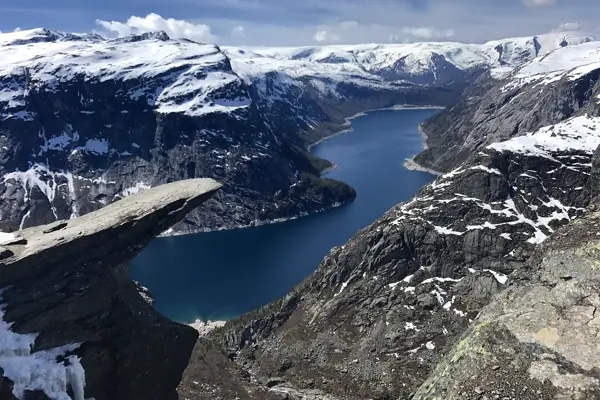
The main season for the fjords, the coast and mountain roads. Days are long everywhere, and north of the Arctic Circle the sun does not set: in Tromsø from 20 May to 22 July, according to Visit Norway. Hiking routes such as Trolltunga and Preikestolen are in season, and ferries and hotels along the classic fjord routes are at their busiest. Pack rain gear anyway: Bergen gets 133 to 257 mm a month in summer.
September and October: autumn
September brings autumn colours, fewer visitors and the first dark nights for northern lights in the north. It is getting cooler: Oslo averages 16.6 °C in September and 10 °C in October. On the west coast, these are among the wettest months, with around 265 to 295 mm in Bergen.
November to February: winter
Cold, dark and, in the north, the time for northern lights, husky and snow trips. According to Visit Tromsø, the polar night begins in late November, when the sun stays below the horizon, and the light returns gradually from mid-January. Oslo averages around 0 °C by day in January, Tromsø -4 °C. The UK travel advice notes that winter is long and can last well into April, and that winter tyres are required when roads are covered by snow or ice. In the mountains, check the avalanche warnings.
March to May: spring
March is still winter in the north, and a good month for northern lights with more daylight. In the south, spring comes in April and May. Some mountain roads open only in late spring, so check road conditions before planning a route across the mountains in May.

Planning by region
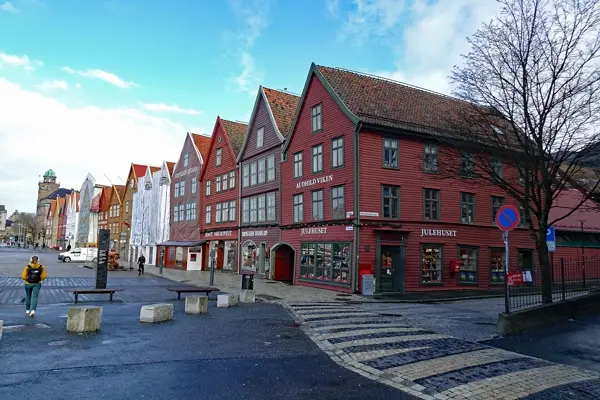
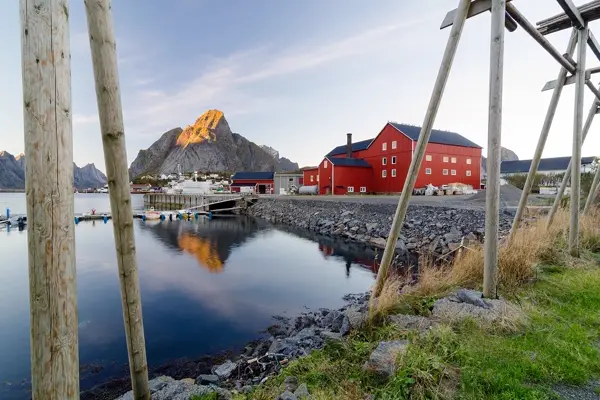
The fjord region around Bergen, Flåm and Geiranger is best from June to August, when all routes and ferries run. Tromsø and the Lofoten Islands work in two seasons: summer for the midnight sun and hiking, winter for northern lights. Oslo is a good city trip all year. For details, see our Norway road trip through the fjords, the midnight sun dates in Norway and where to see the northern lights. For the capital, see how many days in Oslo. A hire car* is the most flexible way to explore the fjords; in winter, drive only with winter tyres and experience on snow.
How YesTrip helps with this trip
In YesTrip you plan Oslo, Bergen and the fjords day by day on one map, including ferries and long drives between the stops. The forecast for your travel days helps you choose the clear day for a viewpoint or a glacier walk, and the packing list adds layers, rain gear and, in winter, warm boots. Travelling as a group, you share the trip and split costs like the hire car, ferries and fuel; the map of your places also works offline, which helps in the fjords where signal can be weak.
Before you go
- Entry: Norway is in the Schengen area but not in the EU. Check the current entry rules for British citizens on gov.uk before you travel.
- Time: Norway is 1 hour ahead of the UK all year.
- Power: 230 volts, sockets type C and F, so bring an adapter from the UK.
- Mobile data: a travel eSIM* can be cheaper than roaming, depending on your UK provider; our eSIM price index compares the prices per gigabyte.
More destinations by month: Best time to visit: where to go when.
* Ad – Partner link: if you book there, we earn a commission. Your price stays the same.
Free
Plan your trip in 30 seconds.
Tell YesTrip where and when – the app plans day by day with real places on the map, shows the weather, splits costs with your travel companions and guides you to the next stop on the go.
Frequently asked questions
What is the best month to visit Norway?
June, July and August for the fjords and a road trip: Oslo averages 20 to 22 °C by day and Bergen about 17 °C, and the days are very long. For northern lights, the dark months from late September to March are better.
When can you see the midnight sun in Norway?
In Tromsø from 20 May to 22 July, according to Visit Norway. The further north you go, the longer the period lasts. In southern Norway, including Oslo and Bergen, the sun does set, but summer nights are very light.
When is the best time to see the northern lights in Norway?
From late September to March, when the nights are dark enough. Around Tromsø the polar night lasts from late November to mid-January, which gives the most hours of darkness but little daylight. Clear skies matter as much as the season.
How cold is Norway in winter?
Oslo averages around 0 °C by day and -5.5 °C at night in January. Tromsø is colder at -4 °C by day and -9 °C at night. Inland and in the mountains it gets much colder; the UK travel advice mentions temperatures of -25 °C and below.
How rainy is Bergen?
Very. In the model data Bergen gets over 100 mm in every month and 230 to 300 mm from August to February. April and May are the driest months; bring rain gear whenever you go.
Sources
- Climate data: Open-Meteo Historical Weather API (ERA5), average 2015–2024 – open-meteo.com
- Copernicus ERA5 reanalysis (Hersbach et al. 2020) – cds.climate.copernicus.eu
- Midnight sun dates by place: Visit Norway – www.visitnorway.com
- Polar night in Tromsø: Visit Tromsø, official tourism website – www.visittromso.no
- Winter, winter tyres and avalanche warnings: UK Foreign Travel Advice for Norway – www.gov.uk
- Road closures and mountain roads: Statens vegvesen – www.vegvesen.no
- Entry requirements for Norway: UK Foreign Travel Advice – www.gov.uk
Researched with AI support and checked by our editors. Prices, opening hours and weather can change – please check before you go. YesTrip is not a travel agency. Published: .
More best-time guides
 When to go
Best time to visit Austria: month by month
For Vienna and the cities, May, June and September are the best months, at 20 to 26 °C by day. For hiking in the Alps and the lakes, June to … · 7 min read When to go
Best time to visit Oman: Muscat and Salalah
The best time to visit Oman is November to March: Muscat sees 24 to 29 °C by day and Nizwa 25 to 31 °C, with cool desert nights. From May to … · 7 min read When to go
Best time to visit Paris, month by month
The best time to visit Paris is May, June and September, with average daytime highs of 19 to 23 °C and long, light evenings. July and August … · 6 min read
All destinations: best time to visit and warm places by month


