
Where to see the northern lights in Europe
In short
The best places to see the northern lights in Europe are northern Norway, Lapland and Iceland from September to March, when nights are long and skies clear. In January the average daytime high is −4.0 °C in Tromsø, −7.0 °C in Rovaniemi and 1.7 °C in Reykjavík. There is never a guarantee – plan at least three to four nights.
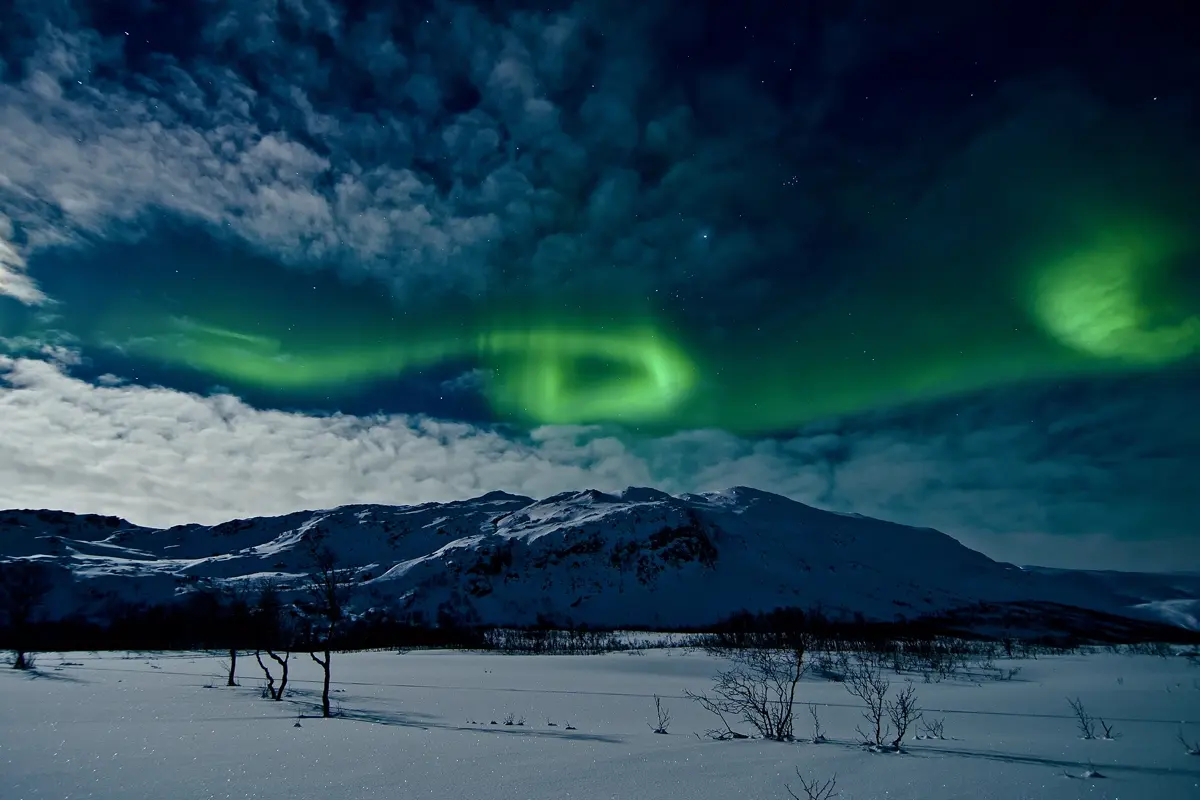
Watching green curtains move across the sky once in your life – for many people that is the reason to fly to the far north in winter. The good news: from most of Europe, the best areas are only a few hours' flight away. The honest news: the northern lights cannot be booked. Whether you see them depends on the activity of the sun, on darkness and above all on the clouds. Here is where your chances in Europe are best, which months to go and how to make the most of the nights.
The short answer
- Where: in northern Norway around Tromsø and on the Lofoten islands, in Swedish Lapland around Abisko, in Finnish Lapland around Rovaniemi, and in Iceland.
- When: roughly September to March. That is when nights are dark for long enough. In summer the far north is too bright, and around Tromsø the midnight sun even shines.
- What matters: a clear, dark sky away from city lights, and patience. Plan at least three to four nights so that one clear one is likely to be among them.
- How: on a guided tour that chases gaps in the clouds, or on your own with a hire car – but then on icy, dark roads.
How the northern lights form
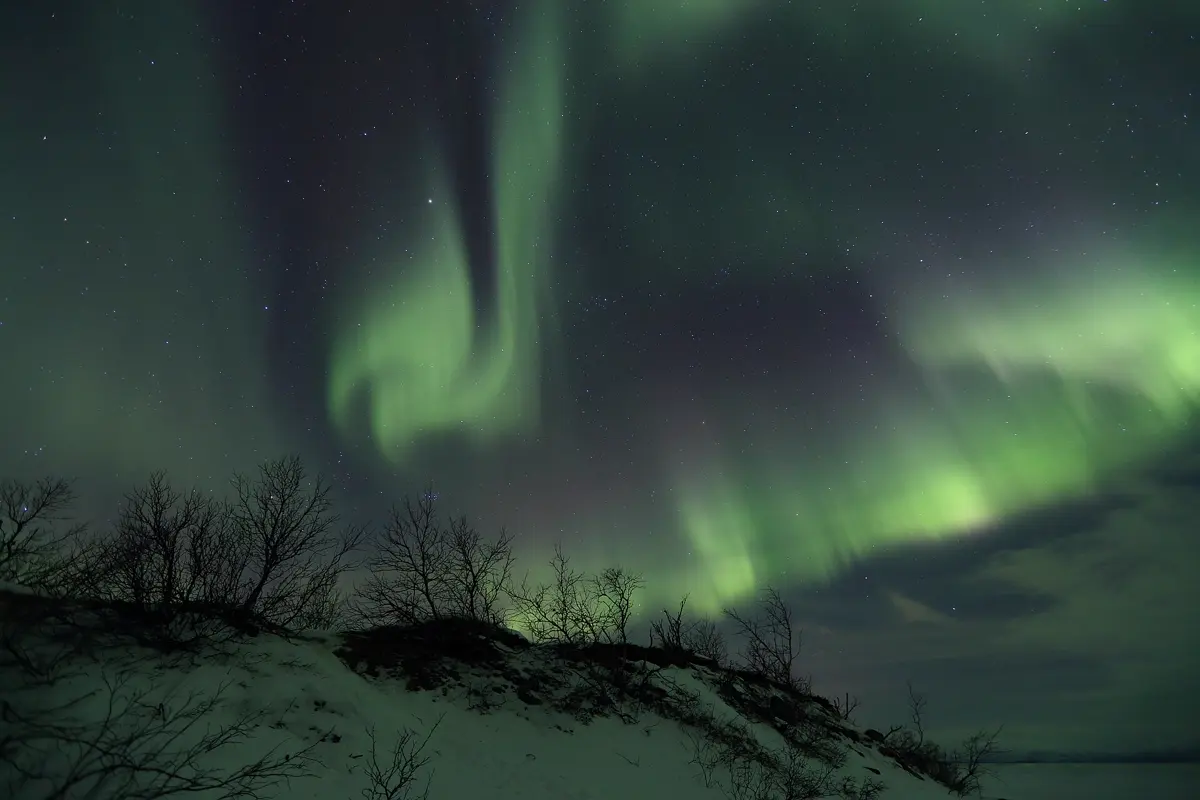
The sun constantly flings charged particles into space, the solar wind. When these particles meet the Earth's magnetic field, they are guided towards the poles and make oxygen and nitrogen atoms glow at heights of more than 100 km. Oxygen usually glows green, and red at great heights; nitrogen glows violet. This happens mostly in a ring around the magnetic north pole, the auroral oval. Northern Norway, northern Sweden, Lapland and Iceland lie beneath this ring or close to it – which is why moderate activity is already enough there.
Solar activity follows a cycle of about eleven years. In the years around the maximum, strong displays are more frequent and can be seen much further south. In the far north, though, the lights are often visible on clear nights even in quieter years.
The best places in Europe
Tromsø: the northern lights city
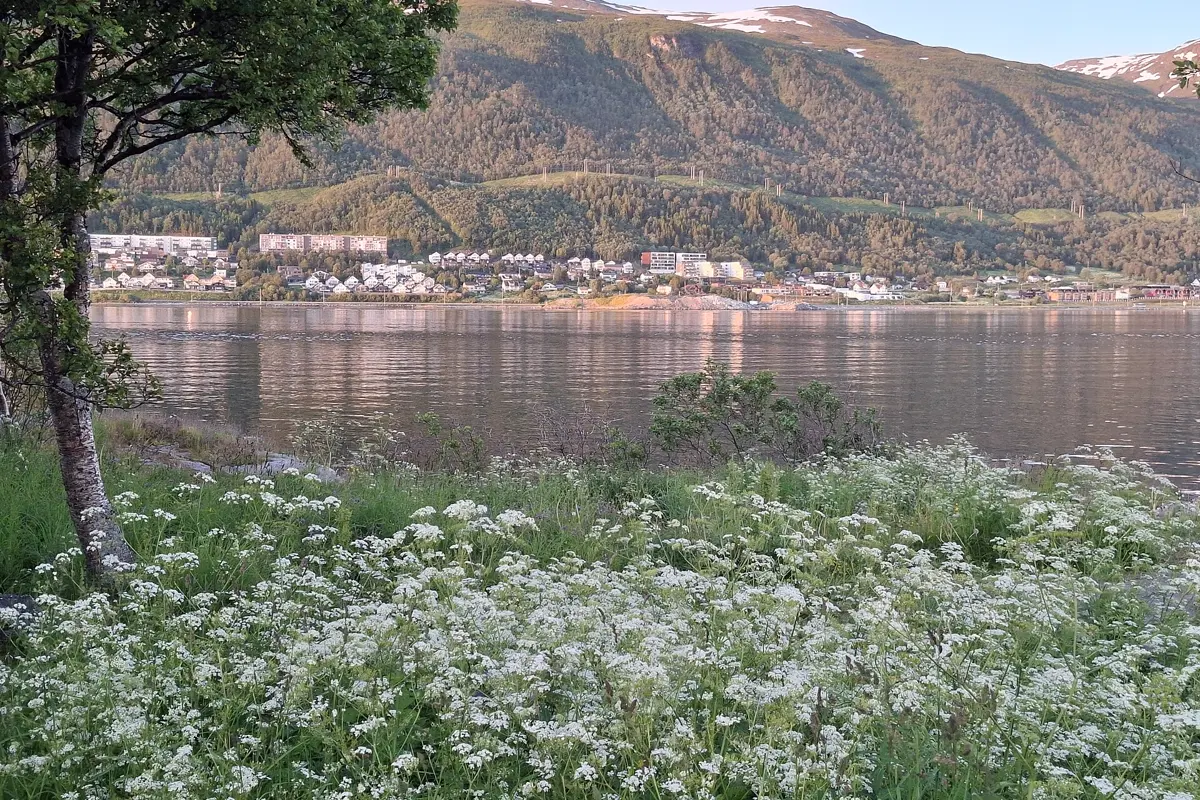
Tromsø lies at almost 70 degrees north, around 350 km north of the Arctic Circle, and is the largest city in northern Norway. That puts it right under the auroral oval. One advantage over smaller places: you get a proper city with restaurants, museums and the Arctic Cathedral, and the cable car up the local mountain, Storsteinen, takes you above the city lights. For the lights themselves, though, you head out of town, to the islands in the west or into the valleys to the east. The coast brings one problem: the weather changes quickly, and in winter more than 110 mm of precipitation falls per month on average. If you are flexible and willing to drive inland, you find a gap in the clouds more often. Tours from Tromsø* can be found at Tiqets, for example.
 Tromsø trip planDay by day, with map and tips
Abisko: Swedish Lapland
Abisko is a small village by the national park of the same name, on the shore of the large lake Torneträsk, just under 150 km south of Tromsø as the crow flies. It lies in the rain shadow of the mountains on the Norwegian border and is therefore considered comparatively dry. The climate data partly bear this out: in January Abisko gets 87 mm on average, Tromsø 134 mm. Abisko is small, remote and dark – ideal for the lights, but with no city life. One plus: it lies on the railway from Stockholm to Narvik, so you can arrive by night train.
Rovaniemi: Finnish Lapland
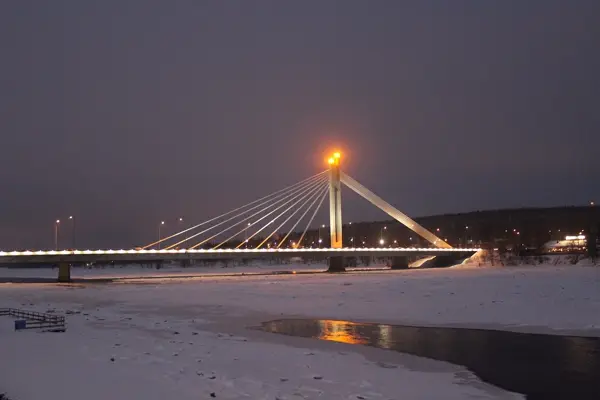
Rovaniemi is the capital of Lapland and lies on the Arctic Circle, where the well-known Santa Claus Village stands. In winter it is much colder than the Norwegian coast, but drier: in January only 43 mm falls on average, and nights average −13.0 °C. The continental weather more often brings long, stable high-pressure spells with clear skies. Around the city there are forests, frozen lakes and rivers where it gets dark quickly. Many visitors combine the aurora nights with husky or reindeer sleigh rides by day. A night train with sleeping cars runs from Helsinki to Rovaniemi.
 Rovaniemi trip planDay by day, with map and tips
Iceland: Reykjavík and beyond
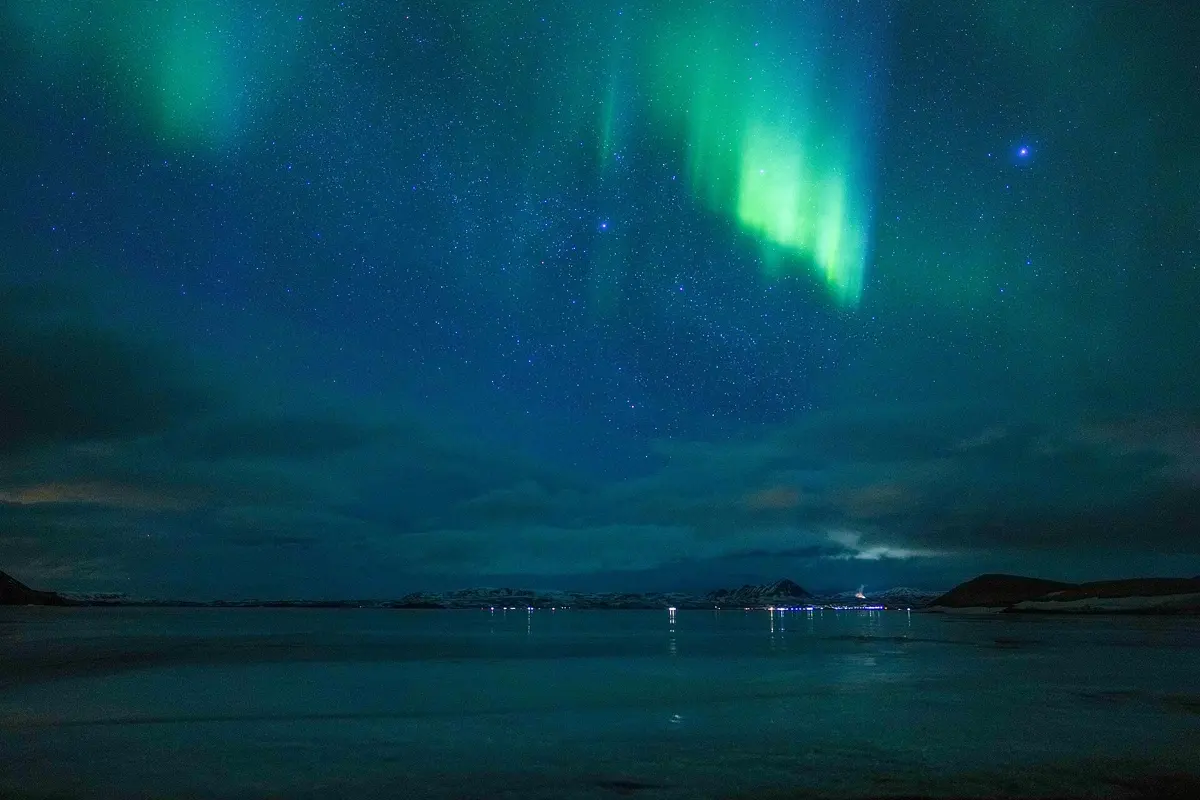
Iceland also lies under the auroral oval, and the landscape of lava, waterfalls and glaciers makes for special photos. Reykjavík is mild – 1.7 °C on average by day in January – but the island's weather is changeable and often cloudy, with 152 mm in January. Within the city, light pollution gets in the way; even half an hour's drive out, towards Þingvellir for example, makes a big difference. It is darker still on the south coast or in the north around Lake Mývatn. Iceland works well if you want to combine the lights with a road trip – see our Iceland Ring Road itinerary.
 Reykjavík trip planDay by day, with map and tips
The Lofoten islands
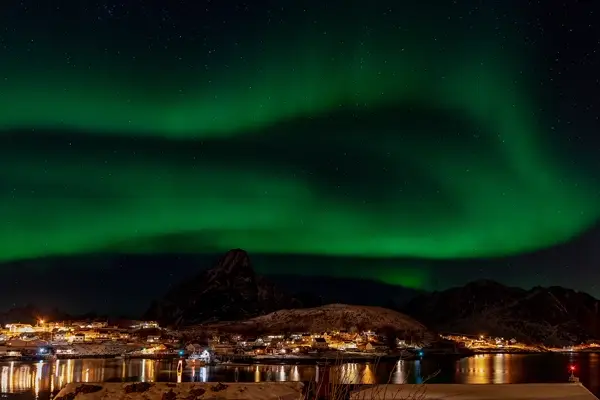
The Lofoten are a chain of islands off the coast of northern Norway, with steep mountains rising straight out of the sea and red fishing cabins on the bays. With the aurora above them, they produce some of the best-known images of the north. The weather is as changeable as in Tromsø. You reach the islands by plane or via Bodø, from where ferries cross over; once there, a hire car gives you the most flexibility.
The best time: September to March
The northern lights happen all year round – but you can only see them when it is dark. In the far north that means roughly September to March. Around Christmas, Tromsø has polar night: from late November to mid-January the sun does not rise at all. That gives you the most hours of darkness, but also the hardest cold and little daylight for excursions.
That is why many people see September/October and February/March as a good compromise: the nights are long enough, it is light during the day, and statistically geomagnetic activity is slightly higher around the equinoxes in March and September. In autumn, lakes and fjords are often not yet frozen, and the lights are reflected in the water. In February and March there is snow almost everywhere.
| Month | Day (avg high) | Night (avg low) | Precipitation |
|---|---|---|---|
| September | 11.5 °C | 6.2 °C | 116 mm |
| October | 4.6 °C | 0.4 °C | 111 mm |
| November | 0.5 °C | −3.8 °C | 107 mm |
| December | −1.8 °C | −6.6 °C | 114 mm |
| January | −4.0 °C | −8.7 °C | 134 mm |
| February | −2.6 °C | −7.3 °C | 117 mm |
| March | −0.7 °C | −5.8 °C | 126 mm |
Tromsø: monthly averages 2015–2024 from the ERA5 reanalysis (Open-Meteo), rounded. Precipitation includes snow (measured as water). The values apply to a grid cell of about 25 km.
Cloud cover cannot be read from these data, and for the northern lights it is what matters most. Precipitation does, however, hint at how changeable the weather is. Compared directly in January:
| Place | Day (avg high) | Night (avg low) | Precipitation in January |
|---|---|---|---|
| Tromsø | −4.0 °C | −8.7 °C | 134 mm |
| Abisko | −6.4 °C | −11.9 °C | 87 mm |
| Rovaniemi | −7.0 °C | −13.0 °C | 43 mm |
| Reykjavík | 1.7 °C | −3.0 °C | 152 mm |
January averages 2015–2024, ERA5 reanalysis (Open-Meteo), rounded.
The pattern: the Norwegian coast and Iceland are milder but wetter and cloudier. Inland Lapland is colder but drier. None of these places can guarantee you a clear sky.
The moon, the time of night and forecasts
The moon: at full moon the sky is noticeably brighter, and faint aurora is lost in the moonlight. Strong displays remain visible, and moonlight lights up the landscape nicely in photos. It is darkest around new moon – if you have the choice, plan your trip for those days.
The time of night: the lights appear most often in the hours around midnight, roughly between 9 pm and 2 am. But they can start in the early evening. They often come in waves: half an hour of nothing, then suddenly half the sky lights up.
The forecasts: there are two kinds. One predicts geomagnetic activity, usually as the Kp index from 0 to 9. Because the far north lies right under the auroral oval, low values of 2 to 3 are often enough there. These multi-day forecasts are rough. Short-term alerts are more precise: satellites measure the solar wind about 1.5 million kilometres in front of the Earth and give roughly half an hour to an hour of warning. The second, equally important forecast is the cloud forecast from the weather service. A clear sky with moderate activity is almost always better than a cloudy one with high activity.
Guided tour or on your own?
Guided tours set off in the evening from Tromsø, Rovaniemi or Reykjavík. The guides know the dark spots, study the cloud forecast and, if necessary, drive a long way to where the sky clears – in northern Norway sometimes as far as Finland. Many provide warm clothing and help with photography. And you are not the one at the wheel when you drive back tired at 2 am. Tours from Rovaniemi* can be found at Klook, for example.
On your own by car you are freer and can stay longer in one spot. Do not underestimate it, though: in winter the roads are often icy and snowy, pitch dark at night, and in the countryside reindeer or elk cross the road. Never stop on the road or on bends – only in car parks and lay-bys. Hire cars there have winter tyres in winter, but ask when you pick yours up. In Iceland, wind and road conditions change quickly and the highlands are closed in winter – check the official weather and road-condition pages before every drive. You can compare hire cars for Iceland* at Localrent, for example.
A middle way: accommodation outside town, in a dark place. Then it is often enough to step outside the door at night.
What to wear
On clear nights it gets colder than the averages show, and you stand still for hours. The layering principle works best:
- Base: long underwear of wool or synthetic fibre, no cotton.
- Mid: fleece or a wool jumper, two layers in severe cold.
- Outer: windproof, insulated jacket and trousers, plus a hat and a scarf or neck gaiter.
- Hands: thin gloves for the camera and thick mittens over them.
- Feet: insulated winter boots with a good tread, wool socks, and ice grips for frozen paths.
- Extras: hand warmers, a flask with a hot drink, a head torch with a red-light mode.
Photographing the northern lights: the basics
- Tripod: you can hardly do without one; exposures last several seconds.
- Settings: manual mode, aperture as wide as possible (around f/2.8), ISO 800 to 3200, exposure 2 to 15 seconds – shorter for bright, fast-moving lights.
- Focus: set manually to infinity, ideally checked beforehand in daylight or on a bright star.
- Wide angle: the aurora often stretches across the whole sky. A foreground such as a mountain, tree or lake makes the picture.
- Phone: modern smartphones have a night mode that captures a surprising amount. Lean the phone against something or use a small tripod.
- Batteries: cold drains them fast. Bring spares and keep them in an inside pocket.
- Condensation: put the camera in a bag before going indoors and let it warm up slowly, otherwise it fogs up.
And now and then, look without the camera. To the naked eye, faint aurora often looks paler than in a photo, while strong displays look more alive.
In summer: the midnight sun
From about mid-May to late July the sun does not set in Tromsø. The northern lights are impossible to see then; instead you can hike, kayak or sit on a Lofoten beach in daylight at midnight. In July the average daytime high in Tromsø is 16.8 °C. For many people that is a second, completely different reason to travel north.
How YesTrip helps
YesTrip has ready-made city plans for Tromsø, Rovaniemi and Reykjavík that you can take over and adapt to your travel days – with the excursions during the day, so your evenings stay free for the lights. The weather forecast for your travel days shows you when the sky might clear. The packing list follows the weather and reminds you of warm layers, gloves and the local plugs. With the offline package you have the map on your phone even outside without signal. If you are travelling as a group, you share the trip and log shared expenses.
* Ad – Partner link: if you book there, we earn a commission. Your price stays the same.
Free
Plan your trip in 30 seconds.
Tell YesTrip where and when – the app plans day by day with real places on the map, shows the weather, splits costs with your travel companions and guides you to the next stop on the go.
Frequently asked questions
When is the best time to see the northern lights in Europe?
From September to March, when nights in the far north are long and dark. September, October, February and March combine long nights with enough daylight. In summer it is too bright, and around Tromsø the midnight sun shines from about mid-May to late July.
Where in Europe are you most likely to see the northern lights?
In northern Norway around Tromsø and on the Lofoten, in Swedish Lapland around Abisko, in Finnish Lapland around Rovaniemi and in Iceland. All of these areas lie under the auroral oval. Nowhere is certain, because you always need a clear sky as well.
How many nights should you plan to see the northern lights?
At least three to four nights, ideally a week. That raises the chance that at least one night is clear while the lights are active. Even then there is no guarantee.
Does a full moon spoil the northern lights?
A full moon brightens the sky, so faint aurora is harder to see. Strong displays remain clearly visible, and moonlight lights up the landscape in photos. The sky is darkest in the days around new moon.
Can you photograph the northern lights with a phone?
Yes, modern smartphones with a night mode often capture the aurora well. The key is to keep the phone still during the exposure of several seconds, ideally on a small tripod or leaning against something. A spare power source helps, because the cold drains batteries quickly.
Sources
- Open-Meteo Historical Weather API (ERA5), averages 2015–2024 – open-meteo.com
- NOAA Space Weather Prediction Center: Aurora – www.swpc.noaa.gov
- NOAA Space Weather Prediction Center: Planetary K-index – www.swpc.noaa.gov
- Wikipedia: Aurora – en.wikipedia.org
- Wikipedia: Polar night – en.wikipedia.org
Researched with AI support and checked by our editors. Prices, opening hours and weather can change – please check before you go. YesTrip is not a travel agency. Published: .
More articles
 Planning & packing
Cherry blossom Japan: when and where, by city
On 1991 to 2020 averages, cherry blossom opens in Tokyo on 24 March and reaches full bloom on 31 March, on 4 April in Kyoto, 13 April in … · 6 min read Planning & packing
Countries that drive on the left: all 54 listed
54 of 195 countries drive on the left, in Europe only the UK, Ireland, Malta and Cyprus. Japan, Thailand, India, Australia, New Zealand and … · 6 min read Planning & packing
Honeymoon destinations by month: 12 places
The right trip depends on your wedding month: January Maldives (27.9 °C, 74 mm of rain), March Cape Town (24.0 °C, 29 mm), June Amalfi Coast … · 7 min read


