
Best time to visit Switzerland: month by month
In short
The best time to visit Switzerland for hiking, lakes and mountain views is mid-June to mid-September: Zurich reaches 23 to 25 °C by day and the high trails are free of snow. September is often the most settled month for the mountains, with fewer visitors. For skiing, come from December to March. Ticino in the south is the mildest region, at 25 to 28 °C in summer and 9 to 11 °C by day in winter.
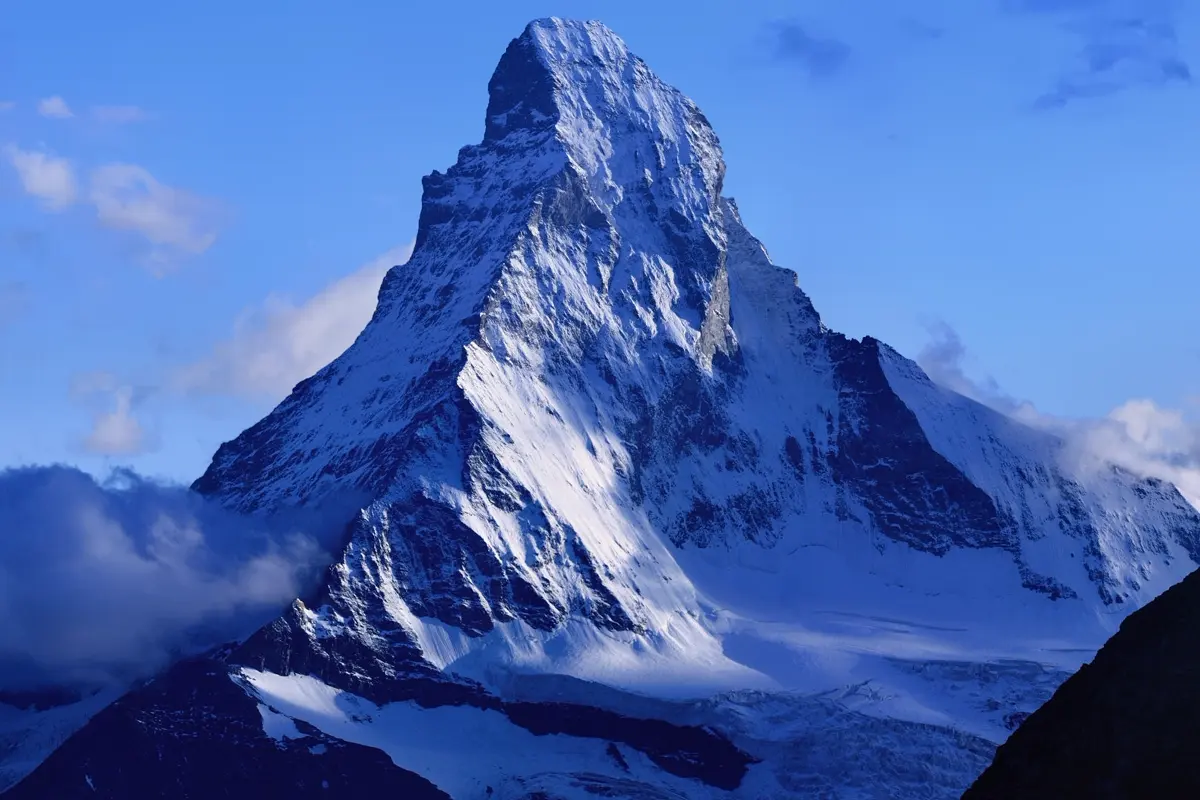
The best time to visit Switzerland for most travellers is mid-June to mid-September: the mountain trails are free of snow, the lakes are warm enough for a swim, and the long days suit excursions to the peaks. September is a particularly good choice, with settled weather and fewer visitors. Winter, from December to March, belongs to skiing. Because the country is mostly mountains, the altitude matters more than the month: in July it can be 25 °C in Zurich and below freezing at night on the glaciers above Zermatt. South of the Alps, Ticino around Lugano has a milder, almost Mediterranean climate. We analysed the weather from 2015 to 2024 at four places.
The short answer
- Hiking and mountain views: mid-June to mid-September. Zurich reaches 23 to 25 °C by day, and the high trails are mostly free of snow from July.
- Best month overall: September. Zurich averages 20 °C by day with less rain than in summer, and the mountains are quieter.
- Skiing: December to March. In the model data for the Zermatt area, the days average around 0 °C from December to February.
- Mildest region: Ticino. Lugano averages 25 to 28 °C in summer and 9 to 11 °C by day from December to February.
- Quietest and cheapest time: April to early June and November, when many mountain railways and hotels close for maintenance.
Switzerland's climate: all 12 months
| Month | Zurich day | Zurich night | Zurich rain | Lugano day | Lugano rain | Interlaken day | Zermatt day |
|---|---|---|---|---|---|---|---|
| January | 4.4 °C | -1.8 °C | 104 mm | 8.6 °C | 60 mm | 6.1 °C | -0.7 °C |
| February | 7.4 °C | -0.9 °C | 74 mm | 10.7 °C | 80 mm | 8.4 °C | 1.5 °C |
| March | 10.8 °C | 1.0 °C | 79 mm | 13.2 °C | 113 mm | 10.9 °C | 2.7 °C |
| April | 14.6 °C | 3.9 °C | 101 mm | 17.0 °C | 127 mm | 14.2 °C | 5.3 °C |
| May | 18.0 °C | 8.4 °C | 148 mm | 20.3 °C | 203 mm | 17.4 °C | 9.4 °C |
| June | 23.1 °C | 13.3 °C | 132 mm | 25.2 °C | 187 mm | 22.6 °C | 15.8 °C |
| July | 25.1 °C | 15.4 °C | 127 mm | 27.9 °C | 168 mm | 24.6 °C | 19.2 °C |
| August | 24.7 °C | 15.4 °C | 127 mm | 27.5 °C | 201 mm | 24.4 °C | 18.7 °C |
| September | 20.0 °C | 11.4 °C | 94 mm | 22.5 °C | 169 mm | 20.2 °C | 14.4 °C |
| October | 15.3 °C | 7.3 °C | 90 mm | 18.3 °C | 232 mm | 16.9 °C | 10.1 °C |
| November | 8.8 °C | 2.6 °C | 95 mm | 12.6 °C | 145 mm | 10.8 °C | 3.8 °C |
| December | 5.7 °C | -0.3 °C | 98 mm | 9.6 °C | 73 mm | 8.2 °C | 1.5 °C |
Temperature and rain: monthly averages 2015–2024 from the ERA5 reanalysis (via Open-Meteo), rounded. A grid cell is about 25 km wide, so the values are a regional average rather than a single weather station. In the Alps this matters a lot: treat the Zermatt and Interlaken figures as a rough guide, because the cell mixes valleys and high peaks. Zermatt village, at about 1,600 metres, is usually warmer than the values in the table, the summits far colder. For official measurements, MeteoSwiss publishes climate normals for its stations.
Zurich has a typical central European pattern: warm summers at 23 to 25 °C and cold winters around freezing at night. May to August are the wettest months, and according to MeteoSwiss, summer rain often falls as thunderstorms in the second half of the day.
Lugano shows the southern pattern MeteoSwiss describes: two rain peaks, one in spring (May) and one in autumn (September and October), with few but heavy rain events. Winters here are mild and often sunny.
Switzerland month by month
June to September: summer in the mountains
The main season for hiking, mountain railways and the lakes. In June, snow often still lies on high trails and passes; from July most routes are open. Zurich, Lucerne and Interlaken reach 23 to 25 °C by day, Lugano 25 to 28 °C. Afternoon thunderstorms are common in summer, so plan high-mountain tours for the morning. September is often the most pleasant month: the weather is frequently stable, the air is clear for views of the peaks, and the summer holidays are over.
October and November: autumn
Early October brings golden larches in the mountains and the grape harvest in Valais, Lavaux and Ticino. Then it becomes quieter: in November many mountain railways and hotels in the resorts close between the summer and winter seasons. In the lowlands north of the Alps, autumn is fog season: according to MeteoSwiss, Zurich-Kloten has fog on every third to fourth day in October, while fog is much rarer at high altitude and south of the Alps. On a grey day in the city, a train up into the mountains often leads into the sun.
December to March: winter and skiing
Ski season in the Alps, from Zermatt and Verbier to St. Moritz and the Jungfrau region. Christmas, New Year and the February school holidays are the busiest weeks. In Zurich the days are around 4 to 7 °C with frequent grey weather, so the city is better for museums and Christmas markets than for views. Ticino is milder, at 9 to 11 °C by day, and often sunny.
April to early June: spring
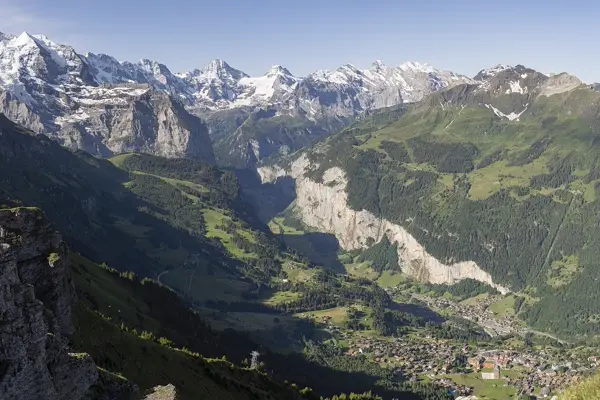
In the valleys and the cities, spring arrives in April and May, with blossoming orchards and waterfalls swollen by snowmelt around Lauterbrunnen. The mountains are in between seasons: the ski season ends, but high trails are still under snow, and some mountain railways close for maintenance. May is one of the wettest months both north and south of the Alps.

Cities, lakes and mountains
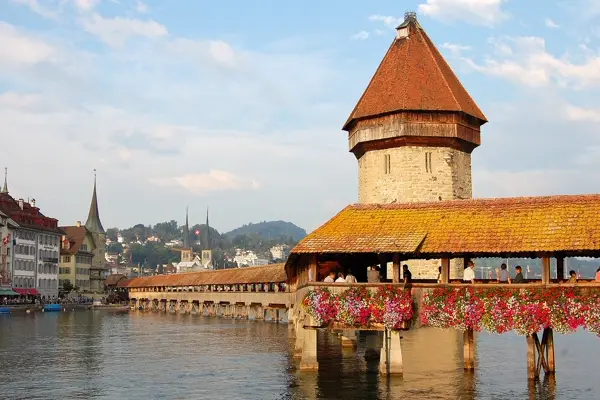
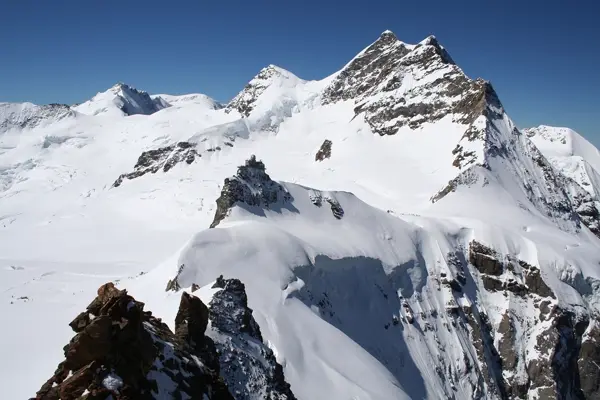
Switzerland is small and its trains are fast and frequent, so cities and mountains combine easily. A first trip of a week often links Zurich, Lucerne, Interlaken with the Jungfrau region, Zermatt and, in summer, Lugano. Trains run all year; a rail pass or ticket* covers most of the network, and many mountain railways give discounts with it. More on the city: how many days in Zurich and the transfer from Zurich Airport to the city centre. For a city break combined with the Alps, see our alpine city breaks; in winter, the Zurich Christmas market.
How YesTrip helps with this trip
In YesTrip you plan Zurich, Lucerne, the Jungfrau region and Zermatt day by day on one map, so you can see how the train connections fit together. The forecast for your travel days shows which day will be clear in the mountains – useful before a trip to a summit – and the packing list adds warm layers, rain gear and the right plug adapter. Travelling with friends, you share the trip and split costs like train tickets, mountain railways and hotels; the map of your places also works offline, which helps on hiking trails without signal.
Before you go
- Entry: Switzerland is part of the Schengen area. Check the current entry rules for British citizens on gov.uk before you travel.
- Time: Switzerland is 1 hour ahead of the UK.
- Power: 230 volts, Swiss sockets type J; slim two-pin plugs (type C) also fit, UK plugs need an adapter.
- Mobile data: Switzerland is not in the EU, so EU roaming rules do not apply there. A travel eSIM* is usually much cheaper than roaming; our eSIM price index compares the prices per gigabyte.
More destinations by month: Best time to visit: where to go when.
* Ad – Partner link: if you book there, we earn a commission. Your price stays the same.
Free
Plan your trip in 30 seconds.
Tell YesTrip where and when – the app plans day by day with real places on the map, shows the weather, splits costs with your travel companions and guides you to the next stop on the go.
Frequently asked questions
What is the best month to visit Switzerland?
September for hiking and mountain views, with 20 °C by day in Zurich, often stable weather and fewer visitors than in summer. July and August are the warmest months, at 25 °C in Zurich and 28 °C in Lugano, but also the busiest and most prone to thunderstorms.
When is the best time to see the Swiss Alps?
From July to September, when the high trails are mostly free of snow and the mountain railways run their summer timetable. Go up early in the day: in summer, clouds and thunderstorms often build in the afternoon.
When is ski season in Switzerland?
Roughly from December to March, and longer in high resorts such as Zermatt and Saas-Fee. The busiest weeks are Christmas, New Year and the February school holidays.
Is Switzerland worth visiting in winter?
Yes, for skiing, winter hiking and Christmas markets. In the lowlands around Zurich it is often grey and around freezing at night, but fog is much rarer up in the mountains. Ticino is the mildest region, at 9 to 11 °C by day.
When does it rain most in Switzerland?
North of the Alps in summer: Zurich gets 127 to 148 mm a month from May to August, often in thunderstorms. In Ticino the peaks are in May and in September and October, with 203 mm in May and 232 mm in October in Lugano.
Sources
- Climate data: Open-Meteo Historical Weather API (ERA5), average 2015–2024 – open-meteo.com
- Copernicus ERA5 reanalysis (Hersbach et al. 2020) – cds.climate.copernicus.eu
- The climate of Switzerland: MeteoSwiss – www.meteoswiss.admin.ch
- Climate south of the Alps, rain peaks in spring and autumn: National Centre for Climate Services (NCCS) – www.nccs.admin.ch
- Fog in autumn (Nebel im Herbst): MeteoSwiss – www.meteoschweiz.admin.ch
- Entry requirements for Switzerland: UK Foreign Travel Advice – www.gov.uk
Researched with AI support and checked by our editors. Prices, opening hours and weather can change – please check before you go. YesTrip is not a travel agency. Published: .
More best-time guides
 When to go
Best time to visit the Seychelles: month by month
The Seychelles are warm all year at around 25 to 28 °C by day, so the best time depends on rain and wind. June to August is driest (63 to 98 … · 7 min read When to go
Best time to visit Singapore: weather, monsoon
Singapore is warm all year: on average 29 to 30 °C by day and 24 to 26 °C at night, whatever the month. The difference is the rain: February … · 5 min read When to go
Best time to visit Sri Lanka: west or east coast
For the west and south coasts the best time is December to March: Colombo then gets only 54 to 168 mm of rain a month, against 422 mm in … · 9 min read
All destinations: best time to visit and warm places by month


