
Best time to visit the Seychelles: month by month
In short
The Seychelles are warm all year at around 25 to 28 °C by day, so the best time depends on rain and wind. June to August is driest (63 to 98 mm a month on Mahé) but brings the strong south-east trade winds; December and January are wettest at 260 to 330 mm. April, May, October and November lie between the two monsoons and are a good compromise.
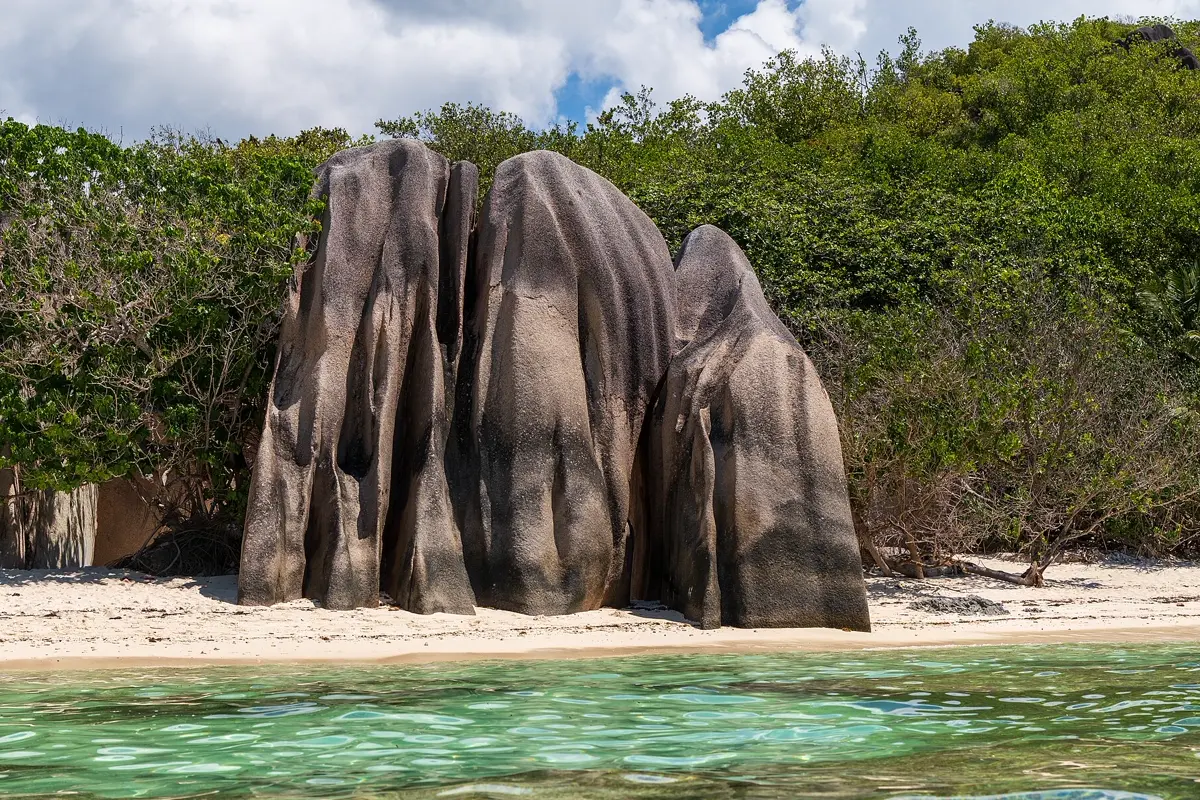
The Seychelles lie just south of the equator in the Indian Ocean, so there is no cold season: the day is warm and the sea is warm in every month. What changes over the year is the wind and the rain. From roughly December to March the north-west monsoon brings humid air, heavy showers and calmer winds; from roughly May to September the south-east trade winds blow steadily, it is drier and a little cooler, and the sea gets rougher on the exposed coasts. We analysed the weather from 2015 to 2024 on the two main islands, Mahé and Praslin.
The short answer
- Best compromise: April and May, October and November – between the monsoons, warm, with lighter winds.
- Driest months: June to August. Only 63 to 98 mm of rain a month on Mahé, but windy and with choppier seas on the south and east coasts.
- Wettest months: December and January, with 260 to 330 mm on Mahé. It still rarely rains all day; showers are usually short and heavy.
- Swimming: possible all year, but pick the coast that is sheltered in your season (see below).
The Seychelles' climate: all 12 months
| Month | Mahé day | Mahé night | Mahé rain | Praslin day | Praslin night | Praslin rain |
|---|---|---|---|---|---|---|
| January | 27.2 °C | 25.5 °C | 260 mm | 26.1 °C | 24.4 °C | 240 mm |
| February | 27.7 °C | 26.0 °C | 172 mm | 26.6 °C | 24.9 °C | 165 mm |
| March | 28.2 °C | 26.4 °C | 146 mm | 27.1 °C | 25.3 °C | 129 mm |
| April | 28.4 °C | 26.4 °C | 188 mm | 27.3 °C | 25.2 °C | 177 mm |
| May | 28.1 °C | 26.3 °C | 195 mm | 26.9 °C | 25.1 °C | 182 mm |
| June | 26.8 °C | 25.5 °C | 98 mm | 25.7 °C | 24.3 °C | 116 mm |
| July | 25.7 °C | 24.5 °C | 68 mm | 24.5 °C | 23.4 °C | 71 mm |
| August | 25.6 °C | 24.5 °C | 63 mm | 24.5 °C | 23.4 °C | 91 mm |
| September | 26.2 °C | 25.0 °C | 129 mm | 25.1 °C | 23.9 °C | 161 mm |
| October | 27.0 °C | 25.5 °C | 132 mm | 25.9 °C | 24.3 °C | 144 mm |
| November | 27.3 °C | 25.6 °C | 203 mm | 26.2 °C | 24.4 °C | 188 mm |
| December | 27.2 °C | 25.4 °C | 330 mm | 26.1 °C | 24.2 °C | 307 mm |
Temperature and rain: monthly averages 2015–2024 from the ERA5 reanalysis (via Open-Meteo), rounded. A grid cell is about 25 km wide, so over these small islands it is mostly sea. That is why the model shows a very small gap between day and night: on land, afternoons are usually a few degrees warmer and nights a little cooler. Treat the temperatures as a rough guide; the seasonal rain pattern is more reliable than the exact numbers.
The temperature curve is flat: on Mahé the warmest month, April, is less than 3 °C warmer than the coolest, August. Whatever month you choose, you need summer clothes.
Rain is the real difference. The dry dip from June to August is clear, as is the wet peak from November to January. Even in the wettest months, the averages hide many sunny hours between the showers.
The Seychelles month by month
December to March: north-west monsoon
The hot, humid season with the most rain, peaking in December and January. Winds are generally lighter and the sea on the south and east coasts is often calm. According to the UK travel advice, the west coast is unsafe for swimming during the north-west monsoon, around December to March, and the risk of flooding and landslides is highest from November to March. Christmas and New Year are a popular time to travel despite the rain.
April and May: the calm transition
The north-west monsoon fades, the trade winds have not yet set in. These are the warmest months at around 28 °C in the model, rain falls in short showers, and the sea is often calm on many coasts. A good time for snorkelling and island hopping.
June to September: south-east trade winds
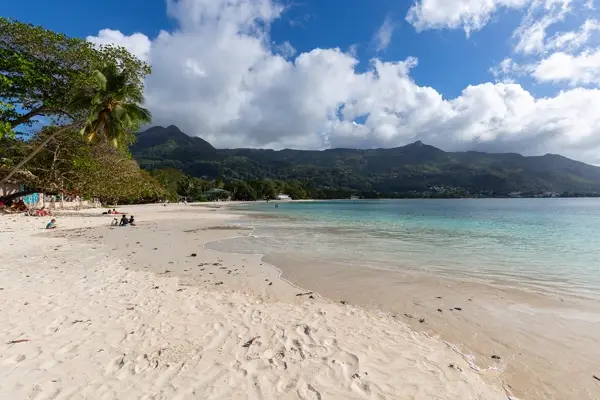
The driest and slightly coolest part of the year, with 63 to 98 mm of rain on Mahé from June to August. The trade winds blow steadily, which keeps the air pleasant but brings waves and seaweed to the exposed beaches. The UK travel advice says the east coast is unsafe during the south-east winds season, around May to September; the north-west beaches such as Beau Vallon on Mahé are then the more sheltered choice.
October and November
The second transition. The trade winds ease, the sea calms down again and rain gradually increases towards December. October is a good month for travellers who want calm water before the wet weeks.
Which coast in which season
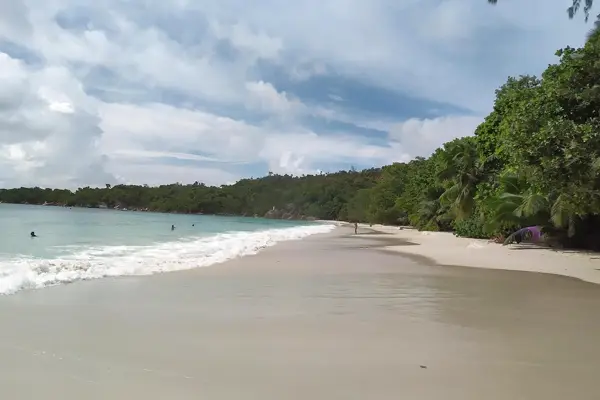
The rule of thumb follows the wind. From May to September, when the south-east trade winds blow, beaches on the north-west side of the islands are more sheltered. From December to March, when the wind comes from the north-west, the south and east coasts are calmer. Not every beach is suitable for swimming: according to the UK travel advice, the beaches at the southern tip are not safe at any time, and Beau Vallon and others can have dangerous rip currents when the sea is rough. Ask locally and keep to marked areas.

Island hopping
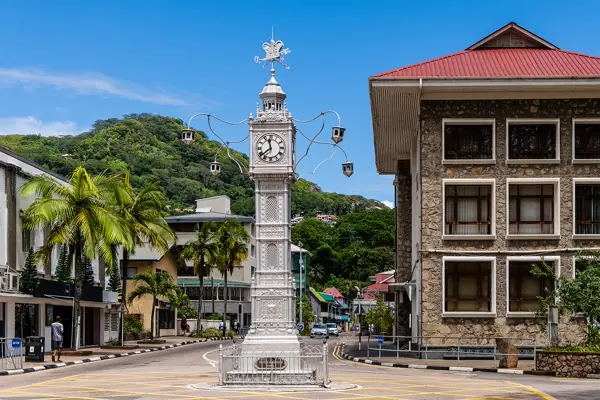
Most trips combine Mahé, where the international airport and the capital Victoria are, with Praslin and La Digue. Ferries link the three islands, and small planes fly between Mahé and Praslin. On Praslin, the Vallée de Mai is a UNESCO World Heritage palm forest with the coco de mer; on La Digue, bicycles are the usual way to get around and Anse Source d'Argent is known for its granite boulders. Ferry crossings are more comfortable in the calm transition months; in the trade wind season the sea between the islands can be rough. On Mahé, a hire car* makes it easy to switch to the sheltered side of the island. Comparing the Indian Ocean? See also the best time to visit Mauritius and the best time to visit the Maldives.
How YesTrip helps with this trip
In YesTrip you plan Mahé, Praslin and La Digue day by day on one map, including the ferry days between the islands. The forecast for your travel days shows when a rain front comes through, so you can move a boat trip or a hike in the Vallée de Mai to a drier day. The packing list suggests sun protection, a light rain jacket and a plug adapter. Travelling as a group, you share the trip and log shared expenses like the hire car and the ferry tickets.
Before you go
- Entry: Check the current entry rules for British citizens on gov.uk before you travel.
- Time: The Seychelles are 4 hours ahead of the UK in winter and 3 hours in summer.
- Power: 240 volts; UK-style three-pin sockets (type G).
- Mobile data: a travel eSIM* is usually much cheaper than roaming; our eSIM price index compares the prices per gigabyte.
More destinations by month: Best time to visit: where to go when.
* Ad – Partner link: if you book there, we earn a commission. Your price stays the same.
Free
Plan your trip in 30 seconds.
Tell YesTrip where and when – the app plans day by day with real places on the map, shows the weather, splits costs with your travel companions and guides you to the next stop on the go.
Frequently asked questions
When is the best time to visit the Seychelles?
April and May as well as October and November, between the two monsoons. It is warm, rain falls in short showers and the winds are lighter. June to August is drier but windier; December and January are the wettest months.
What is the rainy season in the Seychelles?
The wettest period is the north-west monsoon from roughly December to March. On Mahé, December averages 330 mm and January 260 mm of rain. Showers are usually short and heavy, and according to the UK travel advice the risk of flooding and landslides is highest from November to March.
Are the Seychelles good in July and August?
Yes, if you do not mind wind. July and August are the driest months on Mahé with 63 to 68 mm of rain, but the south-east trade winds blow and the sea is rough on the south and east coasts. Beaches on the north-west side, such as Beau Vallon, are more sheltered then.
How warm is it in the Seychelles?
Warm all year. The model averages for Mahé lie between 25.6 °C in August and 28.4 °C in April by day, and on land afternoons are usually a few degrees warmer. There is no month that is too cold for the beach.
Which beaches are calm in which season?
From May to September, when the south-east trade winds blow, the north-west coasts are more sheltered. From December to March, during the north-west monsoon, the south and east coasts are calmer. According to the UK travel advice, the west coast is unsafe in the north-west monsoon and the east coast in the south-east winds season.
Sources
- Climate data: Open-Meteo Historical Weather API (ERA5), average 2015–2024 – open-meteo.com
- Copernicus ERA5 reanalysis (Hersbach et al. 2020) – cds.climate.copernicus.eu
- Weather forecasts and warnings: Seychelles Meteorological Authority – www.meteo.gov.sc
- Monsoons, unsafe coasts, rip currents and flooding: UK Foreign Travel Advice for the Seychelles – www.gov.uk
- Vallée de Mai Nature Reserve: UNESCO World Heritage Centre – whc.unesco.org
- Entry requirements for the Seychelles: UK Foreign Travel Advice – www.gov.uk
Researched with AI support and checked by our editors. Prices, opening hours and weather can change – please check before you go. YesTrip is not a travel agency. Published: .
More best-time guides
 When to go
Best time to visit Singapore: weather, monsoon
Singapore is warm all year: on average 29 to 30 °C by day and 24 to 26 °C at night, whatever the month. The difference is the rain: February … · 5 min read When to go
Best time to visit Sri Lanka: west or east coast
For the west and south coasts the best time is December to March: Colombo then gets only 54 to 168 mm of rain a month, against 422 mm in … · 9 min read When to go
Best time to visit South Africa: weather by region
South Africa has two seasons to choose from: Cape Town is at its best in summer from November to March (25.9 °C in January, only 10 to 29 mm … · 11 min read
All destinations: best time to visit and warm places by month


