
How many sights per day? A 3 to 4 rule of thumb
In short
As a rule of thumb, 3 to 4 sights and one proper meal fit in a travel day if they're in the same area. A big museum counts double and an arrival day counts as half. Of about 9 hours out, roughly 6 are left for the places after food, walking and breaks. Our 110 city plans average 5.3 stops a day, meals included.
"How much can we fit in a day?" has no research-backed answer. There is no solid statistic on it, and any number that sounds like one is usually a guess. What does exist is a calculation you can check yourself: how many hours a day really has, what the bits in between cost, and what's left for the places. Our rule of thumb follows from that, and it is exactly that, a rule of thumb:
3 to 4 sights plus one proper meal, all in the same neighbourhood or two adjoining ones. A big museum counts double. An arrival day counts as half.
The calculation behind it
Take a normal sightseeing day from 9 am to 6 pm. That's 9 hours, and this is where they go. The figures are our assumptions for a relaxed city day; change them if your pace differs.
| Item | Hours |
|---|---|
| Sights | 6 |
| Lunch | 1 |
| Walking, 5 legs | 1.25 |
| Coffee, sitting, finding things | 0.75 |
The 1.25 hours of walking comes from five legs of a kilometre each at a gentle 4 km/h, so 15 minutes a leg. The real route is longer than the straight line, because streets wind. That leaves 6 hours for the places, and they use it up faster than the guidebook suggests:
| Type of place | Example | Time (assumption) | Counts as |
|---|---|---|---|
| Big | Louvre, Vatican Museums, Prague Castle | 2.5 to 3 hours | 2 |
| Medium | Cathedral, small museum, market | 1 to 1.5 hours | 1 |
| Small | Square, bridge, viewpoint | 20 to 45 minutes | 0.5 |
So in 6 hours you get one big museum plus two medium places. Or four medium ones. Or two medium and four small. Two big museums in a day work on paper too, but you'll take little in from the second. That isn't a measurement, just what most people know from a long museum afternoon.

What our own plans show
For comparison we counted: our 110 ready-made city plans cover 329 days with 1,751 stops, an average of 5.3 stops a day. That includes food (294 stops) and a few transport legs; sights and activities alone come to about 4.4 a day.
| Stops per day | Days |
|---|---|
| 3 | 2 |
| 4 | 43 |
| 5 | 141 |
| 6 | 133 |
| 7 | 10 |
This doesn't prove that this is the best way to travel. These are our editorial choices, and many of the stops are small places that take minutes. But the number does show where the practical limit sits: only ten days have seven stops, and those only work with short walks. Your list of ten places for one day isn't ambitious, it's a two-day plan.
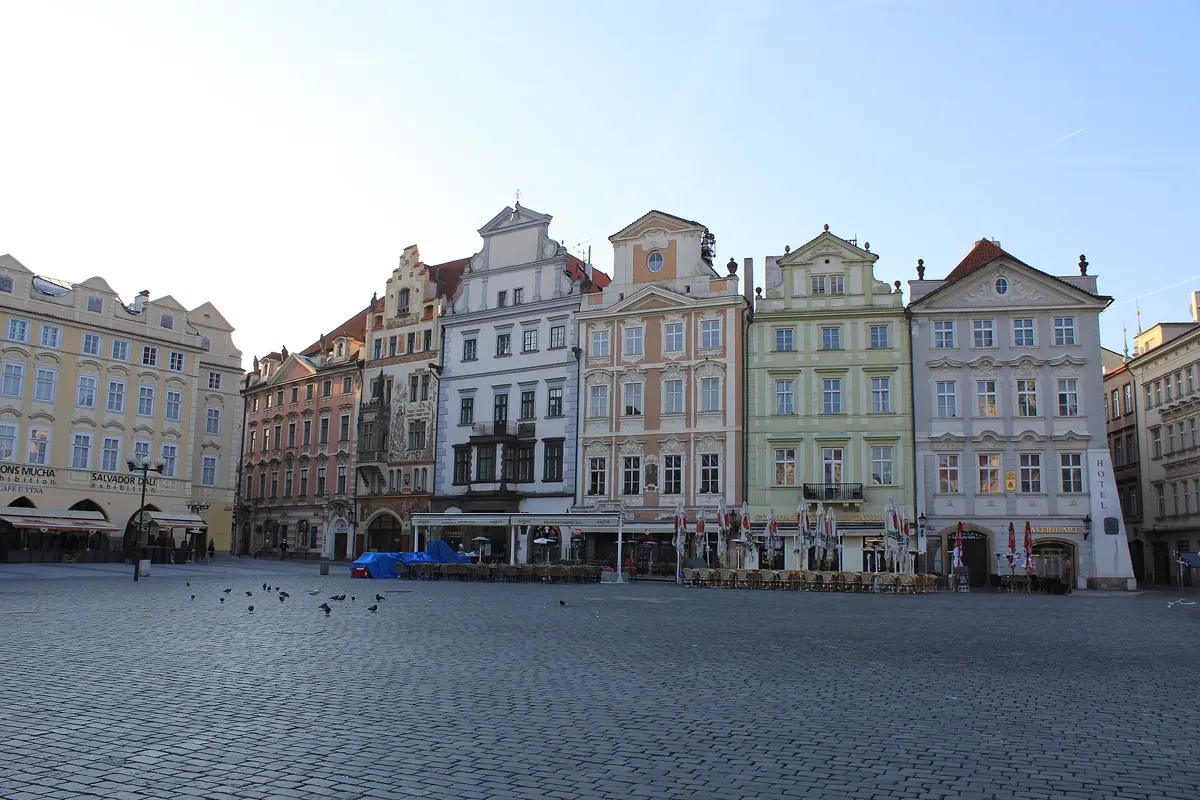
A real day: Prague's Old Town
Here's the rule applied to the first day of our Prague plan. Distances are straight lines between the plan's coordinates.
| Time | Stop | From previous stop | Counts as |
|---|---|---|---|
| 09:00 | Old Town Square | Start | 0.5 |
| 10:00 | Astronomical Clock | 60 m | 0.5 |
| 11:00 | Old Jewish Cemetery | 400 m | 1 |
| 14:30 | Powder Tower | 810 m | 0.5 |
| 15:15 | Municipal House (food, coffee) | 30 m | Break |
| 18:30 | Charles Bridge | 1.15 km | 0.5 |
That's 3 points by our count, spread over six stops and only 2.4 km in a straight line. The day looks full because many of the places are small and right next to each other. The key is the gap in the early afternoon: between 11 am and 2:30 pm there are three and a half hours for the Jewish Quarter, lunch and sitting down. Nobody has to rush, and if you dawdle at eleven, you've lost nothing.
Charles Bridge comes last on purpose, not at 11 am. It suits the evening, and above all you can drop it without the day collapsing. How long to stay overall is in How many days in Prague? For fixed points like the castle or the Jewish Quarter, you can find tickets and guided tours in Prague* at Tiqets.


Group by area first, then count
The rule of thumb only holds if the places are close together. A ride across town easily costs an hour, and with it a whole stop. The order:
- Put all the places on a map, without days. Google Maps is enough, see Plan a trip with Google Maps.
- Make clusters: whatever is within a 15-minute walk becomes one day.
- Count per cluster: more than 4 points? Then it's two days, or something goes.
- Set fixed points: timed tickets and reservations first, ideally in the morning when it's quieter.
- Arrange the rest around them.
How to check the walks yourself is shown in our day-by-day itinerary with walking routes, using Porto as the example. This page only answers how much fits into the day.
Buffer isn't free time, it's part of the plan
Three simple rules that save a lot:
- One stop a day may fall away. Mark it when planning. If it rains, the queue is long or you're tired, you cut it without discussion.
- No appointment right after something open-ended. Leave at least an hour between a museum with no fixed end and a timed slot.
- Every fourth day is a half day. Our rule of thumb: after three full days, plan a morning or afternoon with no programme, for laundry, a park or a long meal. It feels like wasted time when planning, and it's often the day you remember fondly.
When to adjust the number down
| Situation | Instead of 3 to 4 |
|---|---|
| Arrival day | 1 to 2, near the hotel |
| Travel day with a change of place | 1 to 2, each move costs about half a day |
| Jet lag of 5 hours or more | 1 to 2 for the first days, see How to avoid jet lag |
| With children | 2, with a playground between, see City breaks with kids |
| Great heat | 2 to 3, midday indoors or a break |
| Hilly old town | 1 fewer, steps cost more than the map shows |
There are only two reasons to go higher: if the places really are small, or if you're in town for only one day and consciously prefer seeing a lot over experiencing a little. That's a legitimate decision, as long as it is one.
How YesTrip helps with the day
In YesTrip each day starts with a line showing the number of stops, time on the move and distance. That's exactly the view this calculation needs. Without AI, one tap puts a day's stops into a shorter order, and the day check flags closed stops (by OpenStreetMap opening hours), tight gaps and duplicates. You decide what stays. The check doesn't know how tired you are, though, and OpenStreetMap hours can be out of date. You plan the buffer yourself.

To try it out, the ready-made plan from the example above is the easiest start.
If you'd rather keep your plan in a table, copy our travel itinerary template. Coming from outside the EU, an eSIM for the Czech Republic* keeps your walking routes available on the road.
* Ad – Partner link: if you book there, we earn a commission. Your price stays the same.
Free
Plan your trip in 30 seconds.
Tell YesTrip where and when – the app plans day by day with real places on the map, shows the weather, splits costs with your travel companions and guides you to the next stop on the go.
Frequently asked questions
How many sights can you see in a day?
As a rule of thumb, 3 to 4 plus a proper meal, if everything is in the same or adjoining neighbourhoods. A big museum counts double. This is our calculation and not a statistic: of 9 hours, about 6 remain for the places after food, walking and breaks.
How many museums fit in one day?
One big one or two smaller ones. A museum like the Louvre or the Vatican Museums fills half a day by our calculation. Two big ones on the same day are possible, but little of the second tends to stick.
What is the best way to plan a travel day?
Sort the places by neighbourhood first, set at most one fixed appointment a day, preferably in the morning, and mark one stop that may fall away. Leave at least an hour of buffer between open-ended visits and fixed appointments.
How much buffer do I need in a daily plan?
We allow about three quarters of an hour a day for coffee, sitting and finding things, plus one stop that may be dropped. After three full days, a half day with no programme helps.
How many stops do YesTrip plans have per day?
Our 110 ready-made city plans average 5.3 stops a day including food, and about 4.4 without. Most days have 5 or 6 stops, and only 10 of 329 days have 7. Many of them are small places close together.
Sources
- YesTrip: ready-made Prague plan (stops, coordinates, example day) – yestrip.app
- YesTrip: app features (About YesTrip) – yestrip.app
Researched with AI support and checked by our editors. Prices, opening hours and weather can change – please check before you go. YesTrip is not a travel agency. Published: .
More articles
 Planning & packing
Cherry blossom Japan: when and where, by city
On 1991 to 2020 averages, cherry blossom opens in Tokyo on 24 March and reaches full bloom on 31 March, on 4 April in Kyoto, 13 April in … · 6 min read Planning & packing
Countries that drive on the left: all 54 listed
54 of 195 countries drive on the left, in Europe only the UK, Ireland, Malta and Cyprus. Japan, Thailand, India, Australia, New Zealand and … · 6 min read Planning & packing
Honeymoon destinations by month: 12 places
The right trip depends on your wedding month: January Maldives (27.9 °C, 74 mm of rain), March Cape Town (24.0 °C, 29 mm), June Amalfi Coast … · 7 min read


