
Best time to visit Scotland: month by month
In short
The best time to visit Scotland is May to September: Edinburgh then reaches 14 to 18 °C by day and the days are long. May and June are often the best months for the Highlands, before the midge season peaks in July and August. The west is much wetter than the east: Fort William gets 120 to 240 mm a month, Edinburgh 50 to 100 mm. The Edinburgh Festival Fringe runs from 6 to 30 August 2027.
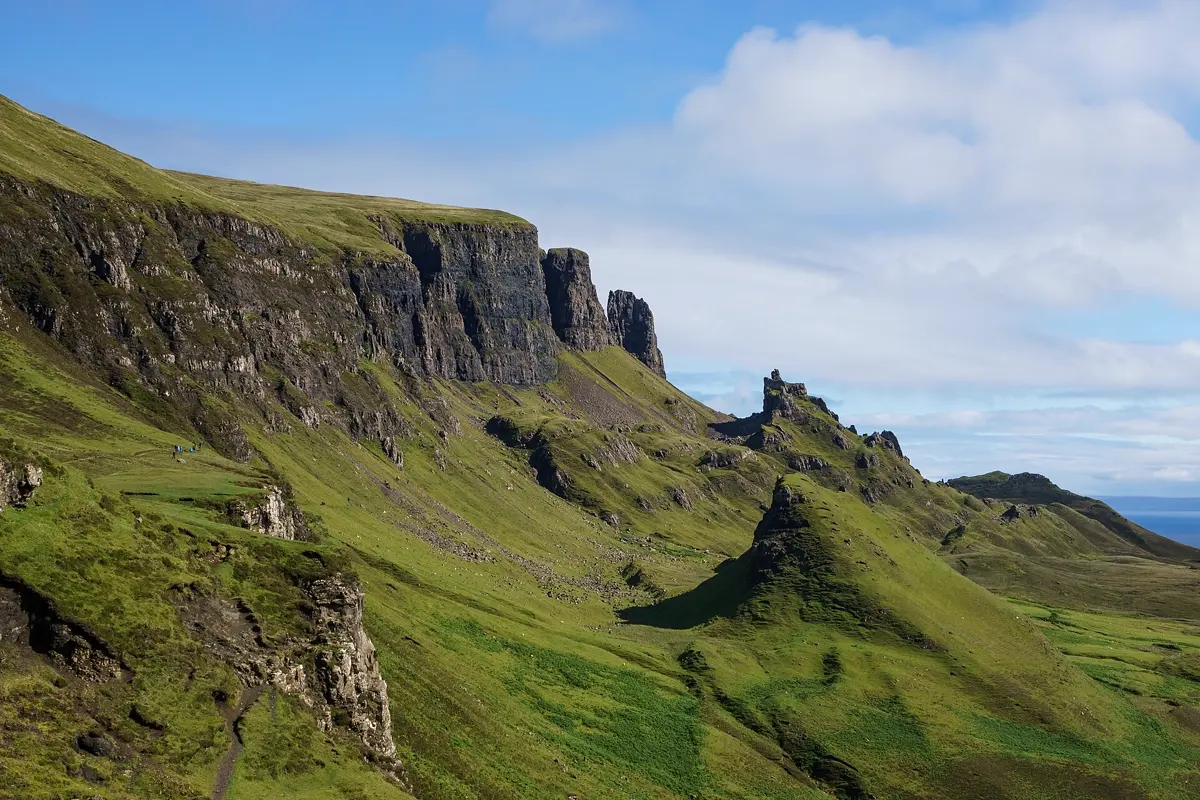
Scotland has a reputation for rain, and it is partly deserved – but the amount depends hugely on where you are. The east around Edinburgh is fairly dry by British standards, while the west coast and the Highlands around Fort William and the Isle of Skye catch the Atlantic weather. Summers are mild rather than warm, and winters cool but rarely very cold at sea level. We analysed the weather from 2015 to 2024 at three places: Edinburgh, Fort William and Portree on Skye.
The short answer
- Best time overall: May to September. Edinburgh averages 13.8 °C by day in May and 16 to 18 °C from June to September.
- Best months for the Highlands and Skye: May and June, and September. Fort William gets 120 to 130 mm in May and June, against 150 to 180 mm in July and August, and the midges are not yet at their peak.
- Midge season: most intense in July and August, fading in September, in the damp, sheltered west.
- Festivals: the Edinburgh Festival Fringe runs from 6 to 30 August 2027 – the city is at its busiest.
- Winter: short days, around 6 to 7 °C by day; the west is very wet, with up to 242 mm in December in Fort William.
Scotland's climate: all 12 months
| Month | Edinburgh day | Edinburgh night | Edinburgh rain | Fort William day | Fort William rain | Portree day | Portree rain |
|---|---|---|---|---|---|---|---|
| January | 6.3 °C | 2.1 °C | 78 mm | 5.9 °C | 223 mm | 6.9 °C | 167 mm |
| February | 7.2 °C | 2.3 °C | 75 mm | 6.6 °C | 218 mm | 7.2 °C | 163 mm |
| March | 8.5 °C | 2.7 °C | 76 mm | 8.5 °C | 167 mm | 8.3 °C | 144 mm |
| April | 10.6 °C | 3.7 °C | 53 mm | 11.2 °C | 90 mm | 10.4 °C | 77 mm |
| May | 13.8 °C | 7.1 °C | 72 mm | 14.7 °C | 120 mm | 13.4 °C | 108 mm |
| June | 16.5 °C | 9.8 °C | 76 mm | 17.0 °C | 130 mm | 15.4 °C | 104 mm |
| July | 18.1 °C | 11.6 °C | 90 mm | 17.7 °C | 153 mm | 16.4 °C | 133 mm |
| August | 17.7 °C | 11.7 °C | 82 mm | 17.4 °C | 176 mm | 16.3 °C | 160 mm |
| September | 15.9 °C | 9.9 °C | 74 mm | 15.7 °C | 160 mm | 14.9 °C | 150 mm |
| October | 12.6 °C | 7.6 °C | 95 mm | 12.2 °C | 208 mm | 12.2 °C | 180 mm |
| November | 8.9 °C | 4.4 °C | 80 mm | 8.6 °C | 176 mm | 9.2 °C | 173 mm |
| December | 7.4 °C | 3.2 °C | 99 mm | 7.0 °C | 242 mm | 7.8 °C | 210 mm |
Temperature and rain: monthly averages 2015–2024 from the ERA5 reanalysis (via Open-Meteo), rounded. A grid cell is about 25 km wide, so the values are a regional average rather than a single weather station. Around Fort William the cell includes high mountains, including Ben Nevis, so it is a rough guide: the summits are much colder and wetter, the town in the glen a little milder.
Temperatures move within a narrow band: Edinburgh is only about twelve degrees warmer in July than in January. A warm summer day in Scotland means around 18 to 20 °C, so pack layers whatever the month.
The west gets two to three times as much rain as Edinburgh. April and May are the driest months there, while October to February are the wettest.
Scotland month by month
April to June: spring and early summer
Often the best time for the Highlands, Skye and the islands. April and May are the driest months in the west, days lengthen quickly, and the summer crowds have not yet arrived. In June the days are at their longest. Midges start to appear from late May, but in smaller numbers than later in the summer.
July and August: summer
The warmest months, at 16 to 18 °C by day, and the main holiday season, so book accommodation on Skye and along popular routes early. In August, Edinburgh is full for the festivals; the Fringe runs from 6 to 30 August 2027. In the west, this is also the height of the midge season: according to a factsheet published on the Scottish Outdoor Access Code website, mass attacks peak in July and August. Midges bite most around dawn and dusk and on dull, overcast days, are rarely found above about 500 metres and cannot fly in a breeze, so windy viewpoints and higher ground are easier. Rain also increases in the west towards August.
September and October: autumn
September is a very good month: still mild at around 15 to 16 °C, quieter after the school holidays, and the midges decline. Autumn colours appear in October, but it is one of the wettest months, with over 200 mm in Fort William.
November to March: winter
Short days and cool weather, at around 6 to 9 °C by day at sea level. Edinburgh is atmospheric at Christmas and Hogmanay, and the Highlands can be beautiful under snow. In the mountains, winter conditions are serious; check the Met Office forecast and road conditions before driving through the Highlands. In the west, expect a lot of rain – up to 242 mm in December in Fort William.
Where the places are
Base map: Natural Earth
From Edinburgh to Fort William via Glencoe is about three and a half hours of pure driving, and Portree on Skye about two and a half hours beyond. A classic first trip combines a few days in Edinburgh with a loop through Glencoe, Skye and Loch Ness; our Scotland road trip has the full route with driving times. For the city itself, see how many days in Edinburgh. A hire car* is the most flexible way to explore the Highlands; many roads on Skye and in the west are single-track with passing places.
How YesTrip helps with this trip
In YesTrip you plan Edinburgh, Glencoe, Skye and Loch Ness day by day on one map, with realistic driving times between the stops. The forecast for your travel days helps you swap a mountain walk for a castle or distillery visit when the rain sets in, and the packing list adds waterproofs, layers and midge repellent for summer in the west. Travelling as a group, you share the trip and split costs like the hire car and fuel; the map of your places also works offline, which helps in glens with weak signal.
Before you go
- Entry: from elsewhere in the UK, no passport check. Visitors from abroad may need an Electronic Travel Authorisation (ETA) – check gov.uk.
- Time: Scotland uses UK time (GMT, BST in summer).
- Power: 230 volts, sockets type G.
- Mobile data: coverage can be weak in remote glens and on the islands; download offline maps before you set off. Visiting from abroad, a travel eSIM* can be cheaper than roaming; our eSIM price index compares the prices per gigabyte.
More destinations by month: Best time to visit: where to go when.
* Ad – Partner link: if you book there, we earn a commission. Your price stays the same.
Free
Plan your trip in 30 seconds.
Tell YesTrip where and when – the app plans day by day with real places on the map, shows the weather, splits costs with your travel companions and guides you to the next stop on the go.
Frequently asked questions
What is the best month to visit Scotland?
May, June and September are the best all-round months. Edinburgh averages 13.8 to 16.5 °C by day in May and June and 15.9 °C in September. In the west these months are drier than July and August, and the midges are fewer.
When is midge season in Scotland?
The Highland midge is a summer nuisance, especially in the damp west and north. According to a factsheet published on the Scottish Outdoor Access Code website, mass attacks peak in July and August, numbers decline in September, and the first frosts end the season until the following May. Midges are most active at dawn and dusk and on overcast days.
When is the Edinburgh Festival Fringe?
The 2027 Fringe runs from 6 to 30 August, according to the official Fringe website. Book accommodation in Edinburgh early; August is the busiest month of the year.
What is the driest time of year in Scotland?
In the west, April and May: Fort William gets 90 and 120 mm, against over 200 mm from October to February. In Edinburgh April is the driest month at 53 mm.
Is Scotland worth visiting in winter?
Yes, for Edinburgh at Christmas and Hogmanay and for snowy Highland landscapes. Days are short and cool, at around 6 to 7 °C by day in January, and the west is very wet. Mountain walking in winter needs experience and the right equipment.
Sources
- Climate data: Open-Meteo Historical Weather API (ERA5), average 2015–2024 – open-meteo.com
- Copernicus ERA5 reanalysis (Hersbach et al. 2020) – cds.climate.copernicus.eu
- Driving times: OSRM route calculation based on OpenStreetMap data – project-osrm.org
- Weather forecasts and warnings: Met Office – www.metoffice.gov.uk
- Highland biting midge, factsheet (Trees for Life), published by the Scottish Outdoor Access Code – www.outdooraccess-scotland.scot
- Festival dates 2027: Edinburgh Festival Fringe – www.edfringe.com
- Entry to the UK: Electronic Travel Authorisation (ETA) – www.gov.uk
Researched with AI support and checked by our editors. Prices, opening hours and weather can change – please check before you go. YesTrip is not a travel agency. Published: .
More best-time guides
 When to go
Best time to visit Switzerland: month by month
The best time to visit Switzerland for hiking, lakes and mountain views is mid-June to mid-September: Zurich reaches 23 to 25 °C by day and … · 7 min read When to go
Best time to visit the Seychelles: month by month
The Seychelles are warm all year at around 25 to 28 °C by day, so the best time depends on rain and wind. June to August is driest (63 to 98 … · 7 min read When to go
Best time to visit Singapore: weather, monsoon
Singapore is warm all year: on average 29 to 30 °C by day and 24 to 26 °C at night, whatever the month. The difference is the rain: February … · 5 min read
All destinations: best time to visit and warm places by month


