
Best time to visit Namibia: dry season and desert
In short
The best time to visit Namibia is the dry season from May to October: it hardly rains, the gravel roads are in good condition, and animals in Etosha gather at the waterholes. June to August are the mildest months, at 21 to 26 °C by day, but nights inland can be cold. From November to April is the rainy season, with up to 88 mm a month in Windhoek and hot days of 30 to 35 °C.
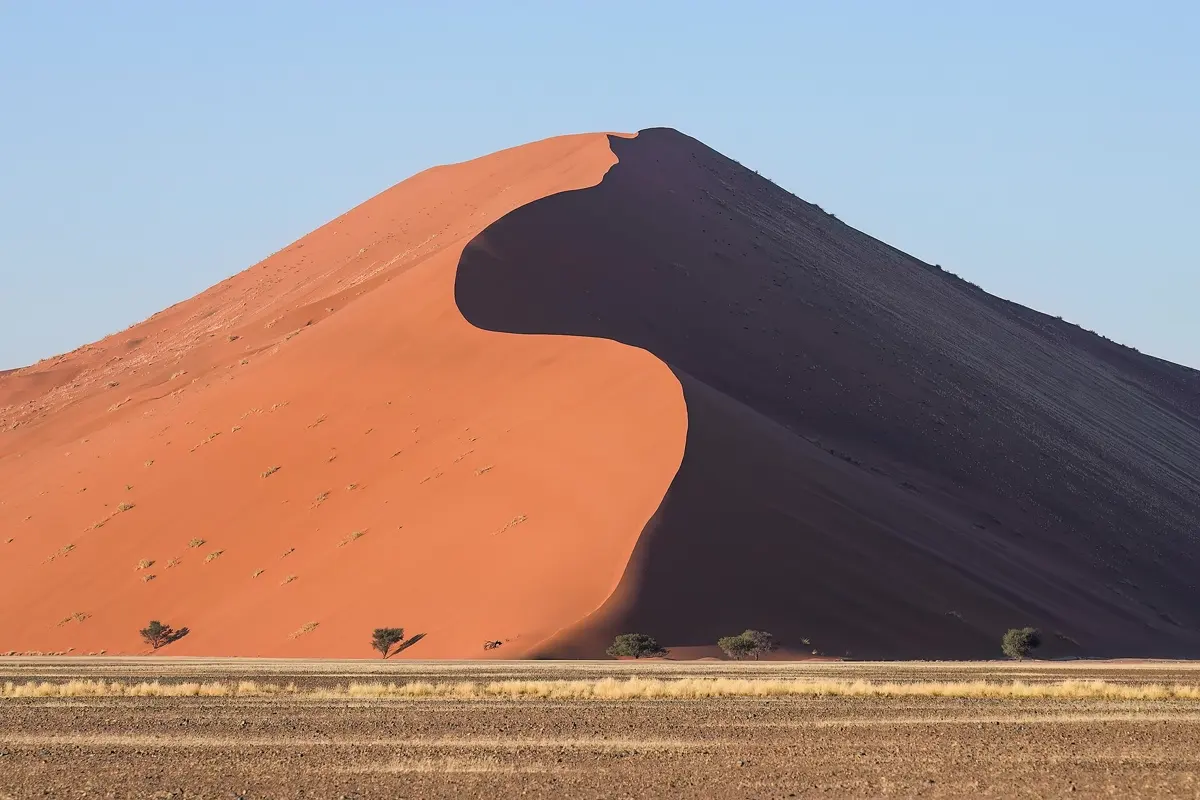
The best time to visit Namibia is the dry season from May to October: there is almost no rain, the long gravel roads are in good condition, and in Etosha National Park the animals gather at the waterholes, where they are easy to see. June to August are the mildest months for a road trip, with warm days and cold nights. From November to April is the rainy season, which according to NASA's Earth Observatory is modest by global standards; Namibia is dry for much of the year and gets around 300 days of sunshine. The rains bring green landscapes and young animals, but also heat and, at times, flooded roads. We analysed the weather from 2015 to 2024 at three places: Windhoek in the highlands, Etosha in the north and Sossusvlei in the Namib Desert.
The short answer
- Best time overall: May to October, the dry season. Windhoek gets 0 to 7 mm of rain a month from May to October.
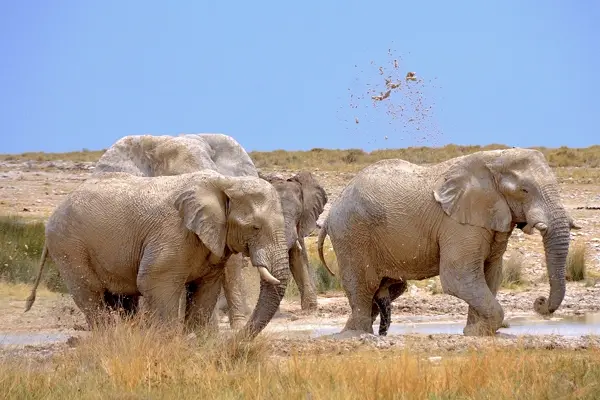
- Safari in Etosha: July to October, when the bush is driest and animals concentrate at the waterholes. By September and October it is hot, at 33 to 35 °C by day.
- Mildest months: June to August, at 21 to 26 °C by day; nights inland fall to around 7 to 11 °C in the model data and can be much colder in the desert.
- Rainy season: November to April. Windhoek gets 43 to 88 mm a month from December to February, and the UK travel advice notes that many gravel roads deteriorate from January to April.
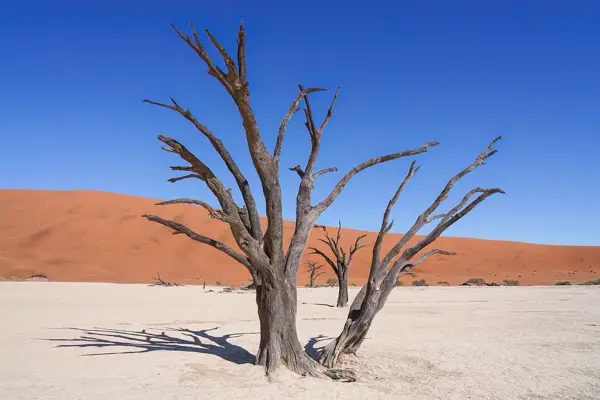
- Sossusvlei and the dunes: all year, but go early in the morning; from October to March the days average 31 to 32 °C.
Namibia's climate: all 12 months
| Month | Windhoek day | Windhoek night | Windhoek rain | Etosha day | Etosha night | Etosha rain | Sossusvlei day |
|---|---|---|---|---|---|---|---|
| January | 30.1 °C | 17.7 °C | 88 mm | 32.1 °C | 20.5 °C | 80 mm | 31.4 °C |
| February | 29.4 °C | 17.1 °C | 62 mm | 32.0 °C | 20.5 °C | 66 mm | 31.9 °C |
| March | 28.1 °C | 16.0 °C | 51 mm | 30.8 °C | 20.4 °C | 69 mm | 32.3 °C |
| April | 26.4 °C | 13.6 °C | 16 mm | 29.8 °C | 18.5 °C | 12 mm | 31.7 °C |
| May | 24.2 °C | 10.8 °C | 1 mm | 28.4 °C | 15.4 °C | 1 mm | 30.2 °C |
| June | 21.2 °C | 7.3 °C | 0 mm | 25.4 °C | 11.4 °C | 0 mm | 26.1 °C |
| July | 21.5 °C | 6.9 °C | 0 mm | 25.7 °C | 11.0 °C | 0 mm | 25.9 °C |
| August | 25.1 °C | 9.2 °C | 0 mm | 29.5 °C | 13.7 °C | 0 mm | 26.8 °C |
| September | 28.7 °C | 12.4 °C | 1 mm | 33.4 °C | 17.6 °C | 0 mm | 29.3 °C |
| October | 30.8 °C | 15.4 °C | 7 mm | 35.1 °C | 20.2 °C | 4 mm | 31.5 °C |
| November | 31.7 °C | 16.5 °C | 9 mm | 34.7 °C | 21.2 °C | 14 mm | 31.7 °C |
| December | 31.2 °C | 17.3 °C | 43 mm | 33.8 °C | 21.3 °C | 49 mm | 31.6 °C |
Temperature and rain: monthly averages 2015–2024 from the ERA5 reanalysis (via Open-Meteo), rounded; Etosha is the area around Okaukuejo. A grid cell is about 25 km wide, so the values are a regional average rather than a single weather station. Treat the night temperatures as a rough guide: in the desert and on clear winter nights it is often much colder than the averages, sometimes close to freezing. Rainfall also varies a lot from year to year, and in the far north-east much more rain falls than in the south and west.
The rain chart shows Namibia's summer rainfall: almost all of it falls between December and March. From May to October it practically does not rain.
Etosha is warm all year: in June and July the days are pleasant at around 25 °C, in October they average 35 °C. The hottest weeks come just before the rains.
Namibia month by month
May to August: the cool dry season
The most comfortable time for a road trip. The days are sunny and mild, at 21 to 26 °C in Windhoek and Etosha, and the air is clear. Nights are cold, especially in the desert and the highlands, so pack a warm jacket for early starts. The vegetation dries out, and from July animals in Etosha increasingly gather at the waterholes. This is also the main travel season, so book lodges and campsites in and around the national parks early.
September and October: hot and dry
The best time for wildlife viewing in Etosha, because water is scarcest and the animals depend on the waterholes. In return, it gets hot: Etosha averages 33 to 35 °C by day. In Sossusvlei, start at sunrise and avoid walking on the dunes in the midday heat.
November to April: the rainy season
Rain usually arrives in short, heavy thunderstorms, mostly in the afternoon, and NASA's Earth Observatory notes that by April the rains are gone. The landscape turns green, many animals give birth and migratory birds arrive. It is hot, at 30 to 35 °C by day. According to the UK travel advice, many gravel roads deteriorate during the rainy season from January to April. In Etosha the animals spread out because there is water everywhere, which makes them harder to find.
The coast: Swakopmund
The Atlantic coast around Swakopmund has its own climate: the cold ocean current keeps it cool, and fog often lies over the coast in the morning. Our grid cell for Swakopmund includes hot inland desert, so it is not shown in the table; on the coast itself, days are usually much cooler than inland. The Namib Sand Sea, a UNESCO World Heritage Site, is the only coastal desert in the world with extensive dune fields influenced by fog.

Planning a self-drive trip
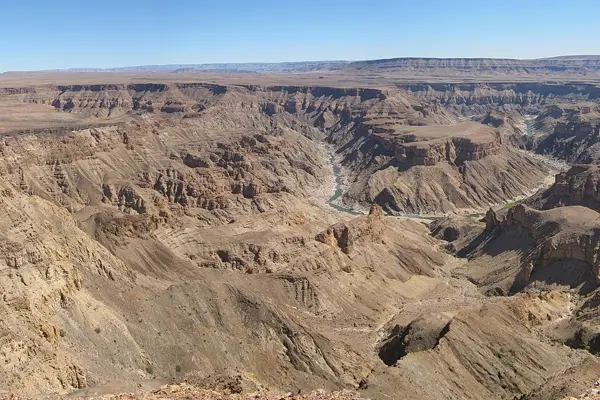
Most visitors explore Namibia by car. A classic first route of two to three weeks runs from Windhoek to Sossusvlei, on to Swakopmund, north through Damaraland and into Etosha, and back to Windhoek. Distances are long and most roads outside the main routes are gravel. The UK travel advice recommends driving no faster than 80 km/h on gravel, carrying two spare tyres and plenty of water, checking road conditions before setting off and avoiding driving at night outside towns, because wildlife and livestock are serious hazards. A hire car*, often a 4x4, is the usual choice; Namibia drives on the left. Combining Namibia with its neighbour? See the best time to visit South Africa.
How YesTrip helps with this trip
In YesTrip you plan Windhoek, Sossusvlei, Swakopmund and Etosha day by day on one map, so you can see how long the drives between them really are. The forecast for your travel days shows heat or a thunderstorm in good time, and the packing list adds sun protection, a warm jacket for cold desert nights and the right plug adapter. Travelling with friends, you share the trip and split costs like the hire car, lodges and park fees; the map of your places also works offline, which helps on remote gravel roads without signal.
Before you go
- Entry: check the current visa and entry rules for British citizens on gov.uk before you travel.
- Health: parts of northern and north-eastern Namibia are malaria areas. Read the official travel health advice and get medical advice in good time.
- Time: Namibia is 2 hours ahead of the UK in winter and 1 hour in summer.
- Power: 220 volts, mostly large round three-pin sockets (type D and M), so bring an adapter.
- Mobile data: a travel eSIM* is usually much cheaper than roaming; our eSIM price index compares the prices per gigabyte. Outside towns, coverage is patchy.
More destinations by month: Best time to visit: where to go when.
* Ad – Partner link: if you book there, we earn a commission. Your price stays the same.
Free
Plan your trip in 30 seconds.
Tell YesTrip where and when – the app plans day by day with real places on the map, shows the weather, splits costs with your travel companions and guides you to the next stop on the go.
Frequently asked questions
What is the best month to visit Namibia?
For a road trip, June to August, when the days are mild at 21 to 26 °C and it does not rain. For wildlife in Etosha, September and October are best, because the animals gather at the waterholes, but the days are hot at 33 to 35 °C.
When is the rainy season in Namibia?
From November to April, according to NASA's Earth Observatory. Most rain falls from December to March, mostly in short thunderstorms: Windhoek gets 43 to 88 mm a month in the model data. From May to October it hardly rains at all.
When is the best time for Etosha?
In the dry season from July to October. The vegetation is thin and the animals depend on the waterholes, which makes them easier to see. In the rainy season they spread out because there is water everywhere.
How hot is Sossusvlei?
Hot during the day for most of the year: from October to April the days average 31 to 32 °C, and from June to August around 26 °C. Nights in the desert can be cold, especially in winter. Visit the dunes early in the morning.
Is Namibia worth visiting in the rainy season?
Yes, if you can live with heat and occasional thunderstorms. The landscape is green, many animals give birth and there are fewer visitors. The UK travel advice notes, however, that many gravel roads deteriorate from January to April, so check road conditions before setting off.
Sources
- Climate data: Open-Meteo Historical Weather API (ERA5), average 2015–2024 – open-meteo.com
- Copernicus ERA5 reanalysis (Hersbach et al. 2020) – cds.climate.copernicus.eu
- Rainy season from November to April and sunshine: NASA Earth Observatory – science.nasa.gov
- Gravel roads in the rainy season and driving advice: UK Foreign Travel Advice for Namibia – www.gov.uk
- Namib Sand Sea: UNESCO World Heritage Centre – whc.unesco.org
- Entry requirements for Namibia: UK Foreign Travel Advice – www.gov.uk
Researched with AI support and checked by our editors. Prices, opening hours and weather can change – please check before you go. YesTrip is not a travel agency. Published: .
More best-time guides
 When to go
Best time to visit New Zealand: month by month
The best time to visit New Zealand is the southern summer from December to March: Auckland reaches 22 to 23 °C by day, Queenstown 19 to 21 … · 7 min read When to go
Best time to visit New York, month by month
The best time to visit New York is May and June or September and October, with average daytime highs of 19 to 26 °C and pleasant evenings. … · 6 min read When to go
Best time to visit Norway: fjords and northern lights
The best time to visit Norway's fjords is June to August: Oslo then reaches 20 to 22 °C by day and Bergen 17 °C, with very long days. In … · 6 min read
All destinations: best time to visit and warm places by month


