
Vietnam itinerary: north to south
In short
The classic Vietnam itinerary runs in 2 to 3 weeks from Hanoi via Ha Long Bay, Ninh Binh, Hue and Hoi An to Ho Chi Minh City and the Mekong Delta. Because the north, centre and south have different rainy seasons, February to April is the best compromise: Hoi An gets 56 mm of rain on average in March and 493 mm in October.
Vietnam is more than 1,600 kilometres long and narrow – so an itinerary here is really a line: from Hanoi in the north to the Mekong Delta in the south, or the other way round. You cover the long distances with domestic flights or the night train, the short ones by car with a driver. This route takes three weeks at a relaxed pace; with two weeks, drop the Mekong Delta and a day in Hue.
The route at a glance
| Day | Leg | Transport | Time |
|---|---|---|---|
| 1–3 | Hanoi | on foot, taxi | – |
| 4–5 | Hanoi → Ha Long Bay (overnight cruise) | car, bus (158 km) | approx. 1:50 h pure driving |
| 6–7 | Ha Long → Ninh Binh | car (176 km) | approx. 2:10 h pure driving |
| 8–10 | Ninh Binh → Hue | night train or flight from Hanoi | flight approx. 1 h |
| 11–14 | Hue → Hai Van Pass → Hoi An | car (125 km via Da Nang) | approx. 1:50 h pure driving |
| 15–17 | Da Nang → Ho Chi Minh City | flight | approx. 1.5 h |
| 18–19 | Ho Chi Minh City → Mekong Delta (Can Tho) | car, bus (175 km) | approx. 2:20 h pure driving |
| 20–21 | back to Ho Chi Minh City, departure | – | – |
Driving times: route calculation based on OpenStreetMap, pure driving time without breaks. On Vietnamese roads progress is slower than the calculation assumes – add about a third. Flight times rounded.
- Hanoi
- Ha Long Bay
- Ninh Binh
- Hue
- Hoi An
- Ho Chi Minh City
- Can Tho
Base map: Natural Earth
Days 1–3: Hanoi
Hanoi is the best start: the Old Quarter, with narrow streets where each one once had its own trade, lies right by Hoan Kiem Lake. On weekend evenings the streets around the lake are closed to traffic. Plan one day for the Old Quarter and street food, one for the Ho Chi Minh Mausoleum, the Temple of Literature and the Museum of Ethnology. Cross the traffic at a steady pace – the scooters flow around you.

Days 4–5: Ha Long Bay
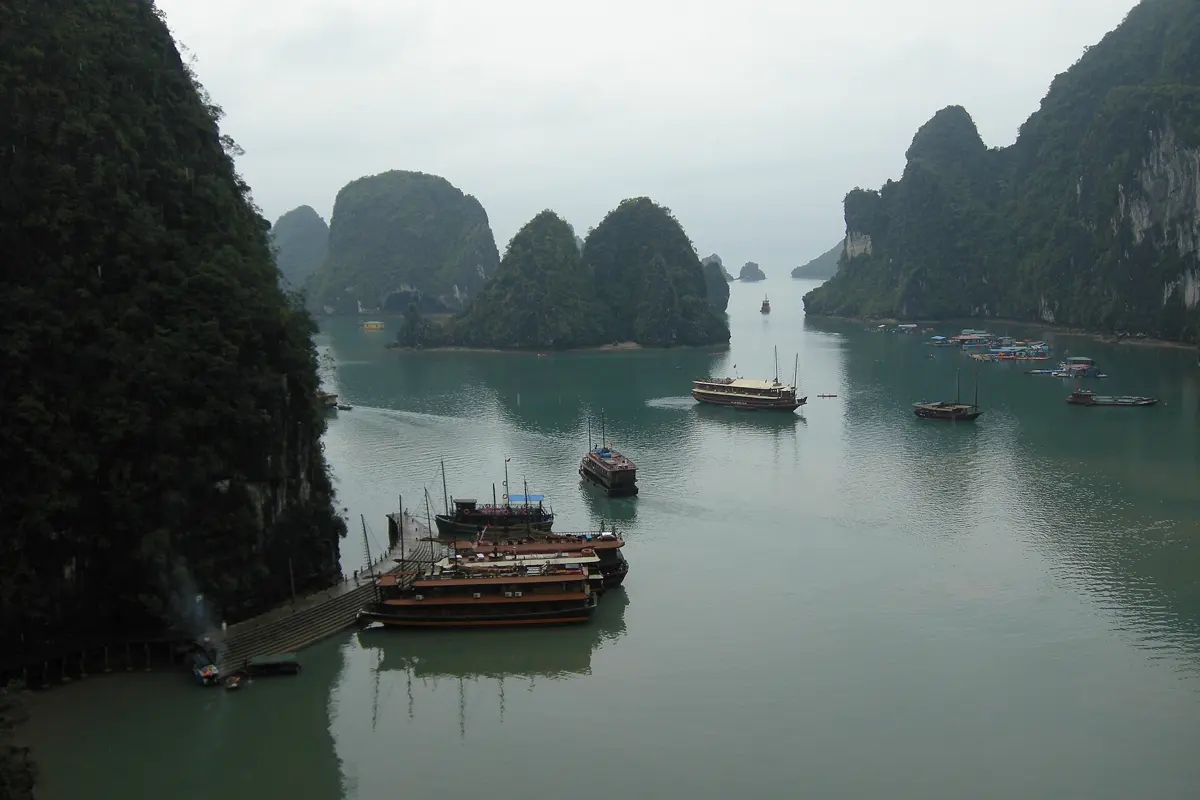
Ha Long Bay, with around 1,600 limestone islands, is a UNESCO World Heritage Site and Vietnam's best-known image. The best way to experience it is an overnight cruise – then you are in the bay in the evening and early morning, after the day boats have gone. Quieter than Ha Long Bay itself are neighbouring Lan Ha Bay and Bai Tu Long Bay, which many operators also sail. Most tours pick you up in Hanoi.
Days 6–7: Ninh Binh
Ninh Binh is often called "Ha Long Bay on land": limestone peaks rise out of rice fields threaded by rivers. In the Trang An landscape complex, also World Heritage, locals row you in small boats through caves and past temples. From the Hang Mua viewpoint you look out over the valley. Ninh Binh is on the railway south from Hanoi – the night train to Hue leaves from here.
Days 8–10: Hue
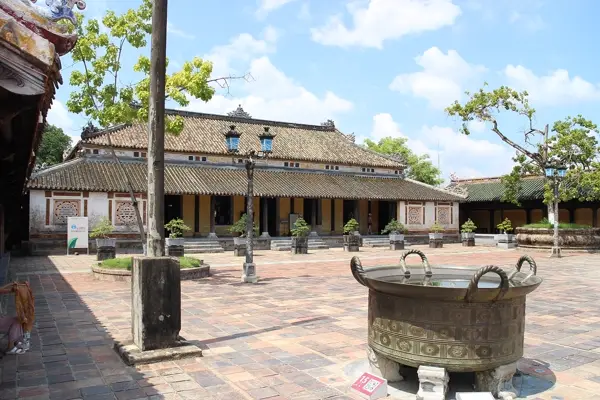
Hue was the imperial city of the Nguyen dynasty until 1945. The citadel with the Purple Forbidden City lies on the Perfume River; upstream are the emperors' tombs set in spacious gardens. If you don't want to sleep on the night train, go back from Ninh Binh to Hanoi (94 km, approx. 1:20 h) and fly to Hue in about an hour.

Days 11–14: Hai Van Pass and Hoi An
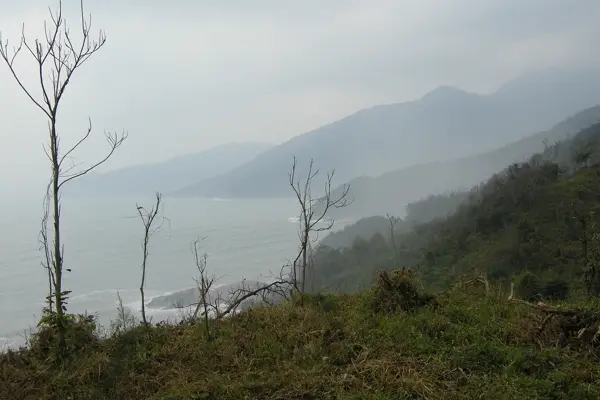
Between Hue and Da Nang the coast road climbs over the Hai Van Pass, with wide views of the sea. By car with a driver it is 125 km to Hoi An, about 1:50 h of pure driving; with stops on the pass and at the beach it makes a lovely half day. The train between Hue and Da Nang also runs along the coast.
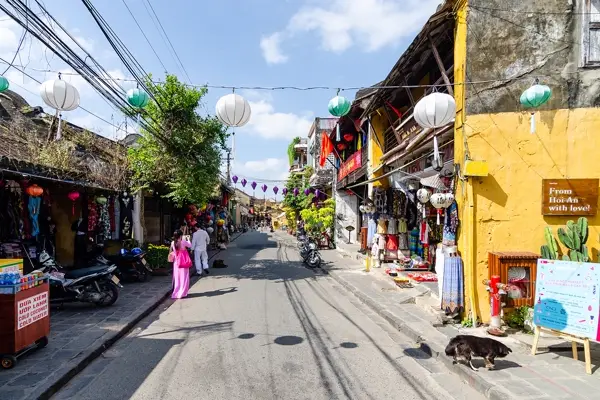
For centuries Hoi An was a trading port for merchants from China, Japan and Europe. The old town with its yellow merchants' houses, the Japanese Bridge and the lanterns along the river at night is a UNESCO World Heritage Site. Four days is a lot – but Hoi An is made for slowing down: rent bikes, ride through the rice fields to An Bang beach, have something made by one of the tailors. The temple ruins of My Son are a half-day trip.
Days 15–17: Ho Chi Minh City
From Da Nang, half an hour from Hoi An, you fly to Ho Chi Minh City in about an hour and a half; many still call it Saigon. The city is bigger, faster and more modern than Hanoi. Worth seeing are Notre-Dame Cathedral and the colonial-era Central Post Office, the War Remnants Museum and Ben Thanh Market. A day trip leads to the Cu Chi tunnels, an underground hiding place during the Vietnam War.
Days 18–21: Mekong Delta
In the south the Mekong splits into many branches before reaching the sea. The Mekong Delta is a land of water, canals, orchards and rice fields. Rather than a day tour, spend a night in Can Tho (175 km, approx. 2:20 h pure driving): early in the morning the Cai Rang floating market takes place there, with traders selling from boat to boat. Then head back to Ho Chi Minh City for your flight – or, if you have time, on to the island of Phu Quoc.

Weather: three regions, three rainy seasons
Vietnam has no single climate. The north around Hanoi has a cool winter and a hot, wet summer with most rain from May to September. The centre around Hue and Hoi An is dry and warm from February to August, but gets heavy rain from September to December; in autumn typhoons can hit the coast. The south is hot all year, with the dry season from December to April.
| Month | Hanoi day | Hanoi night | Hanoi rain | Hoi An rain | Ho Chi Minh City rain |
|---|---|---|---|---|---|
| Jan | 20.8 °C | 14.1 °C | 65 mm | 168 mm | 29 mm |
| Feb | 22.3 °C | 15.3 °C | 48 mm | 83 mm | 13 mm |
| Mar | 25.6 °C | 18.9 °C | 83 mm | 56 mm | 17 mm |
| Apr | 29.0 °C | 21.8 °C | 90 mm | 67 mm | 76 mm |
| May | 31.8 °C | 25.0 °C | 215 mm | 83 mm | 221 mm |
| Jun | 33.5 °C | 26.7 °C | 239 mm | 74 mm | 252 mm |
| Jul | 32.8 °C | 26.4 °C | 305 mm | 152 mm | 296 mm |
| Aug | 31.8 °C | 25.9 °C | 404 mm | 137 mm | 294 mm |
| Sep | 30.8 °C | 24.8 °C | 350 mm | 269 mm | 348 mm |
| Oct | 28.3 °C | 21.8 °C | 186 mm | 493 mm | 305 mm |
| Nov | 26.0 °C | 19.1 °C | 59 mm | 404 mm | 145 mm |
| Dec | 21.2 °C | 14.2 °C | 34 mm | 376 mm | 62 mm |
Temperatures and rain: monthly averages 2015–2024 from the ERA5 reanalysis (Open-Meteo), rounded. Values apply to a grid cell of about 25 km. In Ho Chi Minh City daytime highs stay around 30 to 34 °C all year.
Best time for the trip
For the whole route from north to south, February to April are the best months: Hanoi becomes pleasantly warm at 22 to 29 °C by day, Hoi An gets only 56 to 83 mm of rain a month, and the south is in its dry season. October to December is wettest in the centre – 493 mm on average in Hoi An in October. In December and January the south is dry but Hanoi is cool at 14 °C at night; bring a jacket. In summer the north and south are hot and rainy, while the centre around Hoi An is dry and very hot.
How YesTrip helps with this trip
In YesTrip you set up the itinerary as one trip with every stop – from Hanoi to Can Tho. The AI builds a day plan for each place, the map shows the whole route, and the weather forecast covers your travel days, which helps a lot with three climate zones. The packing list suggests clothes for north and south and the right plug adapter. Travelling with others, you share the trip and settle shared expenses. The map also works offline.
What to know before you go
- Entry: UK citizens and those of several European countries can enter Vietnam visa-free for short tourist stays; for longer trips or other nationalities there is an e-visa, applied for online on the official portal. The rules change – check the current requirements on gov.uk or with your own government.
- Power: 220 volts; European two-pin plugs fit most sockets, UK plugs need an adapter.
- Money: Vietnamese dong. Small eateries and markets take cash.
- Getting around: driving yourself is not recommended for visitors. For overland legs, book a car with driver, a bus or the train.
- Mobile data: a travel eSIM is cheaper than roaming and helps with ride-hailing apps and maps.
Free
Plan your trip in 30 seconds.
Tell YesTrip where and when – the app plans day by day with real places on the map, shows the weather, splits costs with your travel companions and guides you to the next stop on the go.
Frequently asked questions
How many days do you need for a Vietnam itinerary?
Three weeks are ideal for the whole route from Hanoi to the Mekong Delta. With two weeks you can do Hanoi, Ha Long Bay, Ninh Binh, Hoi An and Ho Chi Minh City if you keep Hue short and leave out the Mekong Delta.
When is the best time for a Vietnam itinerary?
February to April. The north is pleasantly warm, the centre around Hoi An is dry (56 to 83 mm of rain a month) and the south is in its dry season. October to December is wettest in the centre, with 493 mm on average in Hoi An in October.
Should you travel Vietnam north to south or south to north?
Both work. North to south makes sense in spring, when Hanoi is pleasantly warm at the start. The important thing is an open-jaw flight: into Hanoi, out of Ho Chi Minh City, so you don't cover the distance twice.
How do you get from Hanoi to Hue?
By plane in about an hour, or by night train, which also stops in Ninh Binh. The night train saves a night's accommodation and fits well with a stay in Ninh Binh.
Do I need a visa for Vietnam?
UK citizens and those of several European countries can enter visa-free for short tourist stays. Longer stays and other nationalities need an e-visa, applied for online. Check the current rules on gov.uk or with your own government.
Sources
- Climate data: ERA5 reanalysis via Open-Meteo, monthly averages 2015–2024 – open-meteo.com
- Driving times: OSRM route calculation based on OpenStreetMap data – project-osrm.org
- Entry requirements for Vietnam: UK Foreign Travel Advice – www.gov.uk
- E-visa: official portal of the Vietnam Immigration Department – evisa.gov.vn
Researched with AI support and checked by our editors. Prices, opening hours and weather can change – please check before you go. YesTrip is not a travel agency. Published: .
More articles
 Road trips & itineraries
Iceland road trip itinerary: Ring Road in 12 days
The classic Iceland road trip follows the Ring Road for 12 days from Reykjavík: Golden Circle, the south coast with Skógafoss and Vík, the … · 8 min read Road trips & itineraries
Ireland road trip: a 10-day itinerary
The classic 10-day Ireland road trip runs from Dublin via Glendalough and Kilkenny to Cork and Kinsale, around the Ring of Kerry, to the … · 7 min read Road trips & itineraries
Japan itinerary: 2 weeks by train
The classic two-week Japan itinerary runs by train from Tokyo via Hakone near Mount Fuji to Kyoto, Nara, Osaka and Hiroshima with the island … · 7 min read


