
Las Fallas Valencia 2027: dates and tips
In short
Las Fallas follows fixed dates: a mascletà daily from 1 to 19 March at 14:00, the Plantà overnight into the 16th, the flower offering on the 17th and 18th, the Nit del Foc on the 18th and the Cremà on 19 March, a Friday in 2027. Around 800 monuments burn from 20:00. The 2027 programme isn't out yet. The best short trip is Thursday 18 to Saturday 20 March.

Las Fallas has one advantage for planners that many festivals lack: its main dates depend on the calendar, not on Easter or the moon. The Cremà always falls on 19 March, Saint Joseph's Day. The official 2027 programme had not been published by early November 2026, so the times below come from the 2026 programme. The short answer: in 2027 the main days run from Monday 15 to Friday 19 March. For two nights, arrive on Thursday 18 March and leave on Saturday 20 March.
Las Fallas 2027: the dates
| Event | Date 2027 | Time (2026 programme) |
|---|---|---|
| La Crida, opening at the Serranos Towers | last Sunday of February: 28 February | evening |
| Mascletà on Plaza del Ayuntamiento | daily 1 to 19 March | 14:00 |
| Plantà, setting up the monuments | night of 15 into 16 March | children's fallas ready on the 15th, big ones on the 16th |
| Ofrenda, flower offering | 17 and 18 March | from 15:30 |
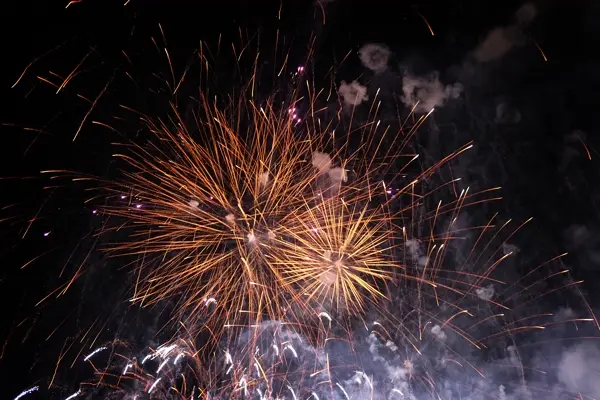
| Nit del Foc, the big firework display | 18 March | just before midnight |
| Cremà, the burning | 19 March | 20:00 to 23:00 |
Rules and order from Visit València. YesTrip worked out the 2027 weekdays; check the times once the 2027 programme is out.
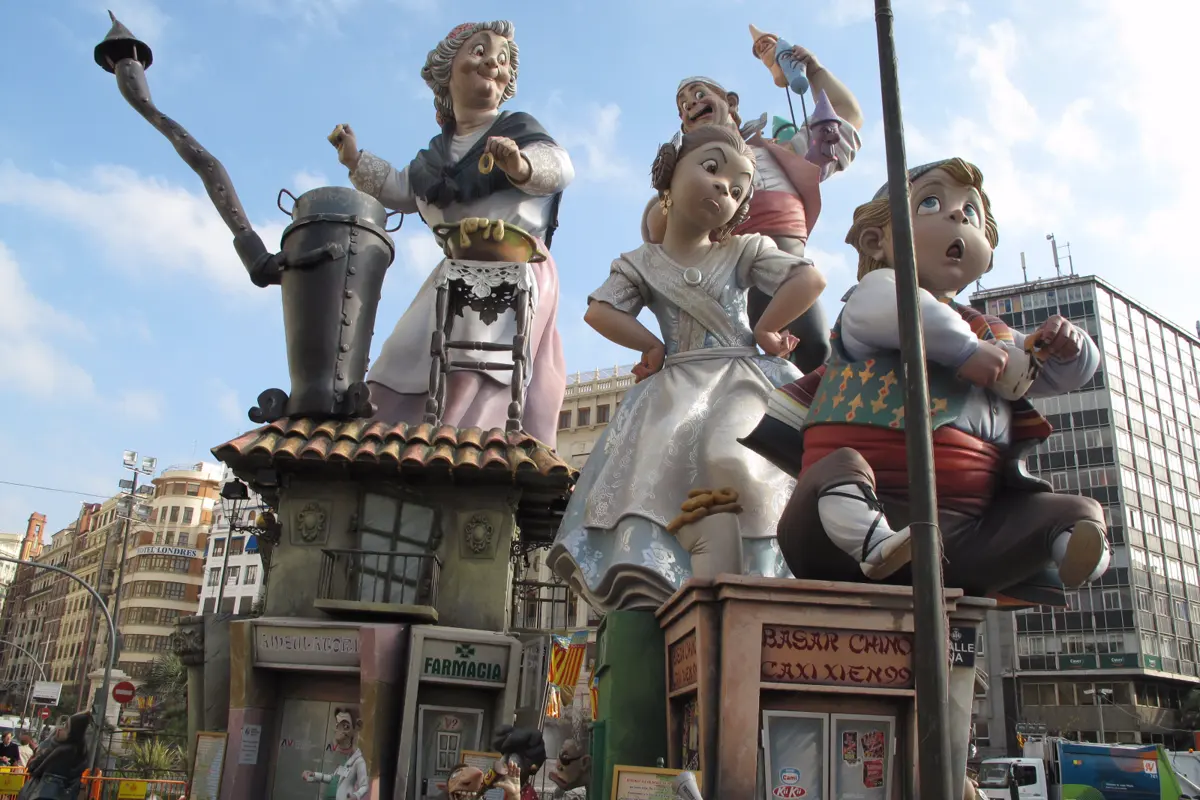
UNESCO has listed the Fallas as intangible cultural heritage since 2016. There are around 800 monuments, about half of them children's fallas, made of wood and papier-mâché and commenting on current events.
Which days should you choose?
In 2027 the climax falls mid-week, and the weekend of 13 and 14 March comes before it. That leaves three real options:
- The weekend before (13 to 15 March): no big monuments on the streets yet, but mascletàs, weekend night fireworks and fewer people. Visit València says crowds are smaller in the first half of the month. On the evening of the 15th you catch the start of the Plantà.
- The short core (18 to 20 March): Ofrenda, Nit del Foc and Cremà, with every monument standing. This is the pick for two nights, but also the busiest days.
- The whole week (15 to 20 March): the Plantà, the monuments calmly by daylight, and everything else. Worth it if you want to see many fallas.
For a first visit, choose the core over the weekend, because without monuments and without the Cremà you miss what most people come for. Book rooms for it early.
The mascletà: in the square at 14:00
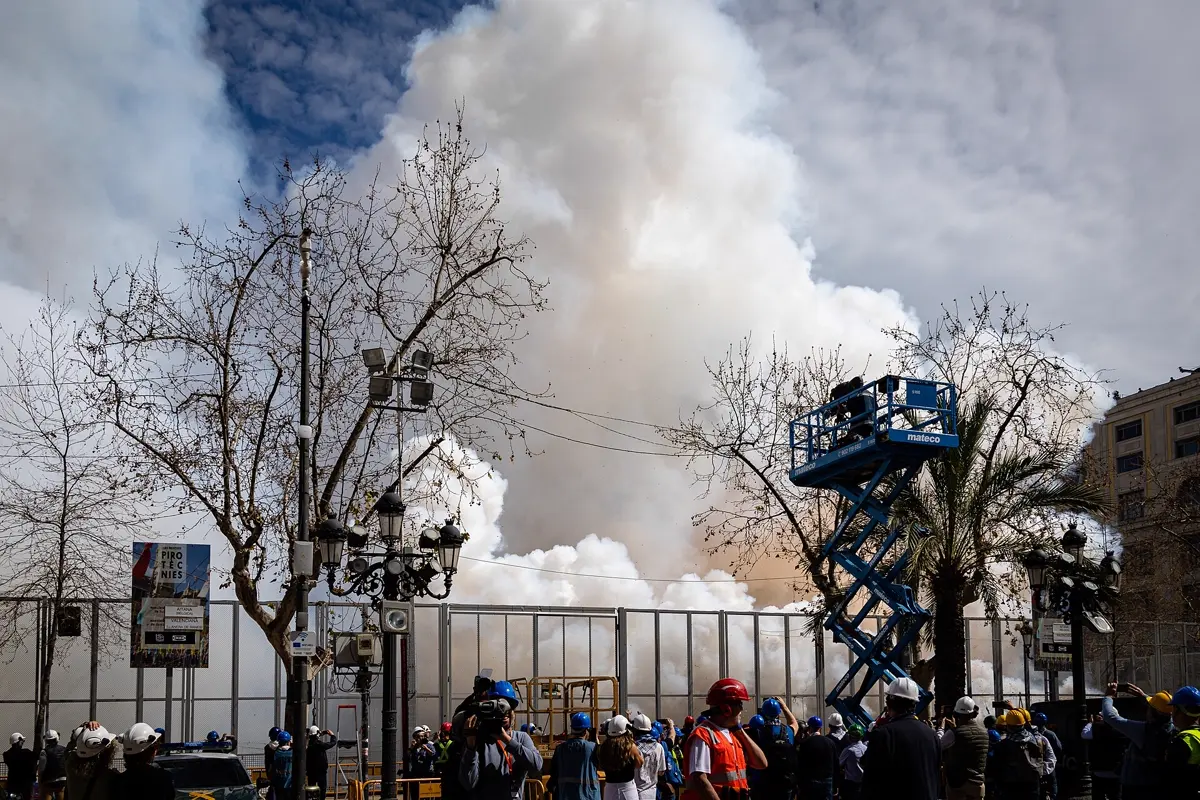
A mascletà isn't a firework display to watch, it is one to feel: a daytime barrage of explosions that keeps building. From 1 to 19 March there is one every day at 14:00 on Plaza del Ayuntamiento, with the Falleras Mayores giving the signal from the balcony. Visit València says people gather up to an hour before on the big days of 15 to 19 March. Many fallas also fire their own mascletà in the neighbourhood at around 14:30 or 15:00, so go to one of those if the square is too full. Children should wear ear protection.
See the monuments before they burn
For the Ninot Exhibition, each commission selects one figure, and visitors vote on which one to save from the fire. In 2026 it ran from 7 February to 15 March at the Museu de les Ciències. Pardoned figures since 1934 stand in the Fallas Museum, which is also the answer if you can't come in March.
The Special Section winners can be visited from the inside from 16 to 19 March, with tickets. Much of the satire needs explaining, so Visit València recommends a guided tour; look at tours around Valencia* on Tiqets. In the evening, Visit València points to Ruzafa for its street lights.
Flower offering and Nit del Foc
On the afternoons of 17 and 18 March, the falleros walk in costume along Calle de la Paz and Calle San Vicente to Our Lady of the Forsaken and cover her in flowers until after midnight. It is the calmest and most personal part of the festival. The floral mantle stays visible from 19 to 23 March, so you can still see it if you miss the Cremà.
On 18 March, just before midnight, comes the Nit del Foc, held at the Monteolivete Bridge in 2026. Expect a long walk back.
The Cremà: in this order
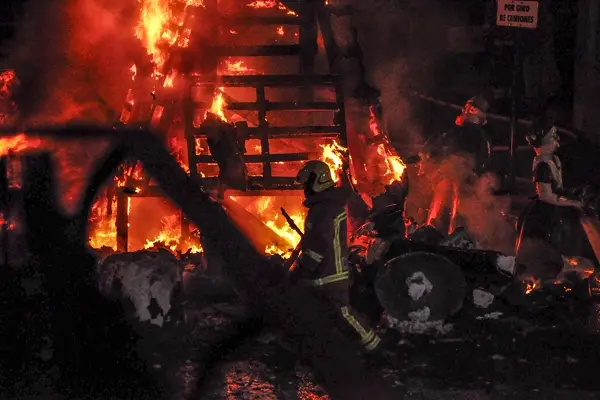
19 March happens in stages. In 2026 it went like this: at 19:00 the Fire Parade from Calle de la Paz to Porta de la Mar, at 20:00 the children's fallas, at 20:30 the winning children's falla, at 21:00 the children's falla on Plaza del Ayuntamiento. At 22:00 the big fallas burn, at 22:30 the Special Section winner, and at 23:00, last of all, the one on Plaza del Ayuntamiento.
That suggests a simple plan: watch your neighbourhood falla at around 22:00, where you stand closer to the fire and among the locals. The City Hall square at 23:00 is the famous one, but it takes patience and space.
Weather and getting there
| Month | Day (avg. high) | Night (avg. low) | Rain per month |
|---|---|---|---|
| Feb | 17.0 °C | 7.6 °C | 18 mm |
| Mar | 18.7 °C | 9.3 °C | 71 mm |
| Apr | 20.1 °C | 11.0 °C | 41 mm |
Averages 2015–2024 from the ERA5 reanalysis (via Open-Meteo), rounded.
The days are mild, but the nights of the Nit del Foc and the Cremà are long and cool, so bring a jacket. Getting from the airport is covered in Valencia airport to the city centre. For the days afterwards, see how many days in Valencia.
One more option: 19 March 2027 is also the Friday of Sorrows, when the first brotherhoods of Holy Week go out in Seville. So you can go straight from the Cremà to Semana Santa in Seville 2027. You can search for a train from Valencia to Seville* on Omio.
Where to stay
- Ciutat Vella: right in the old town, near City Hall square and the Ofrenda. Loud and crowded, with little chance of sleep before midnight.
- Ruzafa: plenty of fallas, street lights and bars. Good for the nights, but no quieter.
- Around the City of Arts and Sciences: further from the centre and calmer, near the Nit del Foc.
How YesTrip helps
YesTrip has a ready three-day plan for Valencia with times and a map. Copy it into the app and add the mascletà and the Cremà as fixed points. "What's on" lists festivals and public holidays during your trip, with a note when a date still needs checking. The weather for your travel days is in the app, and the offline package helps when the network is overloaded in the crowds. YesTrip is free and a planner; you book with the provider.

 Valencia trip planDay by day, with map and tips
* Ad – Partner link: if you book there, we earn a commission. Your price stays the same.
Free
Plan your trip in 30 seconds.
Tell YesTrip where and when – the app plans day by day with real places on the map, shows the weather, splits costs with your travel companions and guides you to the next stop on the go.
Frequently asked questions
When is Las Fallas in Valencia in 2027?
The main days are 15 to 19 March 2027, Monday to Friday. Festivities begin earlier with the Crida on the last Sunday of February, the 28th in 2027, and daily mascletàs from 1 March.
Has the Fallas 2027 programme been published?
Not as of early November 2026. The main dates stay the same each year, and the times here come from the 2026 programme. Visit València and the city publish the new programme ahead of the festival.
When do the fallas burn?
On the evening of 19 March. In 2026, the Cremà began at 20:00 with the children's fallas, the big fallas followed at 22:00, and the falla on Plaza del Ayuntamiento burned last at 23:00.
What is a mascletà?
A daytime sequence of firecrackers that you feel more than see. There is one every day from 1 to 19 March at 14:00 on Plaza del Ayuntamiento, and many fallas fire their own in the neighbourhood afterwards.
How many days do I need for Las Fallas?
Two nights from 18 to 20 March 2027 are enough for the Ofrenda, Nit del Foc and Cremà. To also see the Plantà and the monuments in peace, arrive on 15 March.
Sources
- Visit València: the Fallas, dates and overview – www.visitvalencia.com
- Visit València: what are the Fallas? – www.visitvalencia.com
- Visit València: Fallas events calendar 2026 – www.visitvalencia.com
- UNESCO: Valencia Fallas festivity – ich.unesco.org
- Fallas.com: Junta Central Fallera – www.fallas.com
- Climate data: Open-Meteo Historical Weather API, daily values 2015–2024 – open-meteo.com
Researched with AI support and checked by our editors. Prices, opening hours and weather can change – please check before you go. YesTrip is not a travel agency. Published: .
More articles
 Planning & packing
Cherry blossom Japan: when and where, by city
On 1991 to 2020 averages, cherry blossom opens in Tokyo on 24 March and reaches full bloom on 31 March, on 4 April in Kyoto, 13 April in … · 6 min read Planning & packing
Countries that drive on the left: all 54 listed
54 of 195 countries drive on the left, in Europe only the UK, Ireland, Malta and Cyprus. Japan, Thailand, India, Australia, New Zealand and … · 6 min read Planning & packing
Honeymoon destinations by month: 12 places
The right trip depends on your wedding month: January Maldives (27.9 °C, 74 mm of rain), March Cape Town (24.0 °C, 29 mm), June Amalfi Coast … · 7 min read


