
Thailand itinerary: 2 weeks
In short
The classic two-week Thailand itinerary runs from Bangkok via Ayutthaya to Chiang Mai and Chiang Rai and ends at the beach. From November to March the Andaman coast around Phuket and Krabi is driest (Phuket gets 29 mm of rain in February), while the Gulf islands around Koh Samui get most of their rain from October to December (288 mm in November).
Thailand is the easiest country for a first long-haul trip to Asia: good connections, plenty of places to stay at every budget and a route that combines city, culture, mountains and beach in two weeks. The most important decision is the beach at the end – because the two coasts have their rainy seasons in different months.
The route at a glance
| Day | Leg | Transport | Time |
|---|---|---|---|
| 1–3 | Bangkok | Skytrain, boat, taxi | – |
| 4 | Bangkok → Ayutthaya → Bangkok | train or car (78 km) | approx. 1:00 h pure driving |
| 5–8 | Bangkok → Chiang Mai | flight or night train | approx. 1 h flight |
| 9 | Chiang Mai → Chiang Rai | bus or car (186 km) | approx. 3:00 h pure driving |
| 10–14 | Chiang Rai → beach (Krabi/Phuket or Koh Samui) | flight, usually changing in Bangkok | – |
Driving times: route calculation based on OpenStreetMap, pure driving time without breaks. In Bangkok traffic and with stops, add about a third. Flight times rounded.
- Bangkok
- Ayutthaya
- Chiang Mai
- Chiang Rai
- Krabi
Base map: Natural Earth
Days 1–3: Bangkok
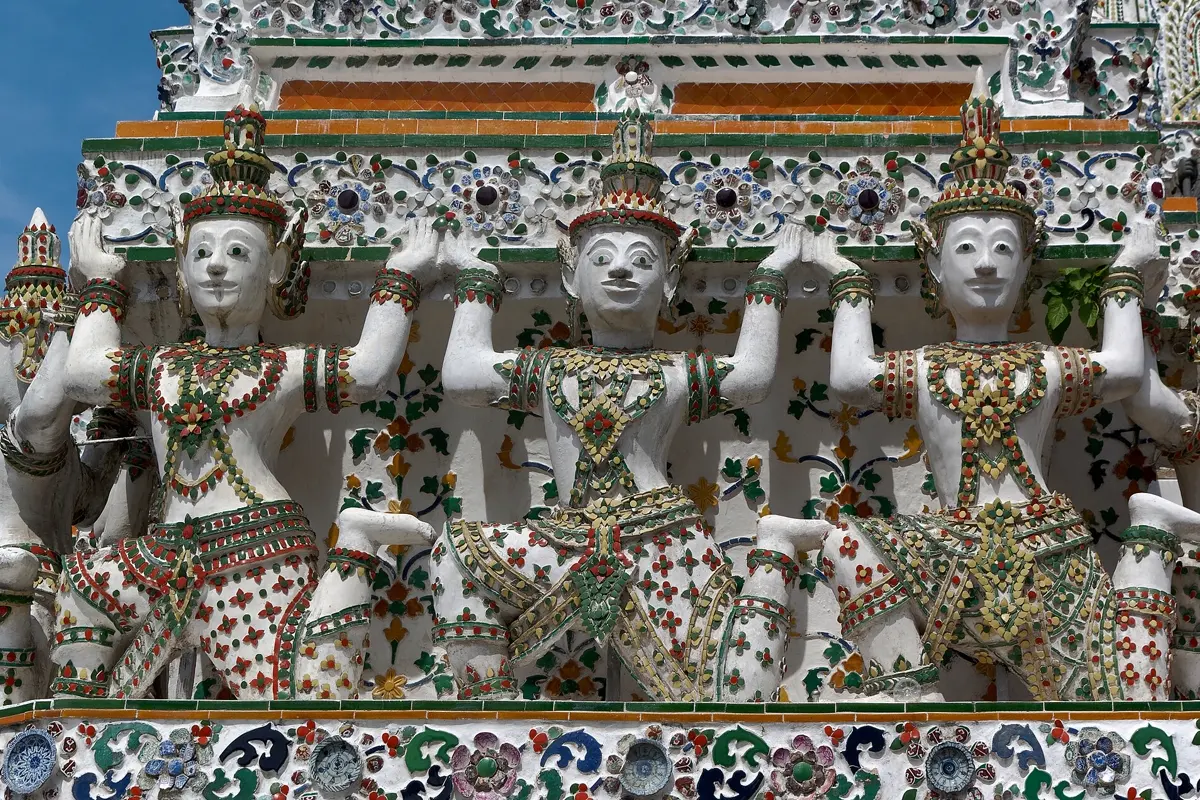
Bangkok is loud, hot and full of contrasts – you need three days to arrive and see the essentials. On day one, the Grand Palace with the Temple of the Emerald Buddha and Wat Pho with its reclining Buddha are close together. Take the ferry across the Chao Phraya river to Wat Arun, which is in its best light in the late afternoon. In the evenings, head to Chinatown with its street kitchens or one of the rooftop terraces above the city.
The fastest way through traffic is the Skytrain (BTS), the metro (MRT) and the river boats. For the temples you need clothes that cover shoulders and knees.
 Bangkok trip planDay by day, with map and tips
Day 4: Ayutthaya
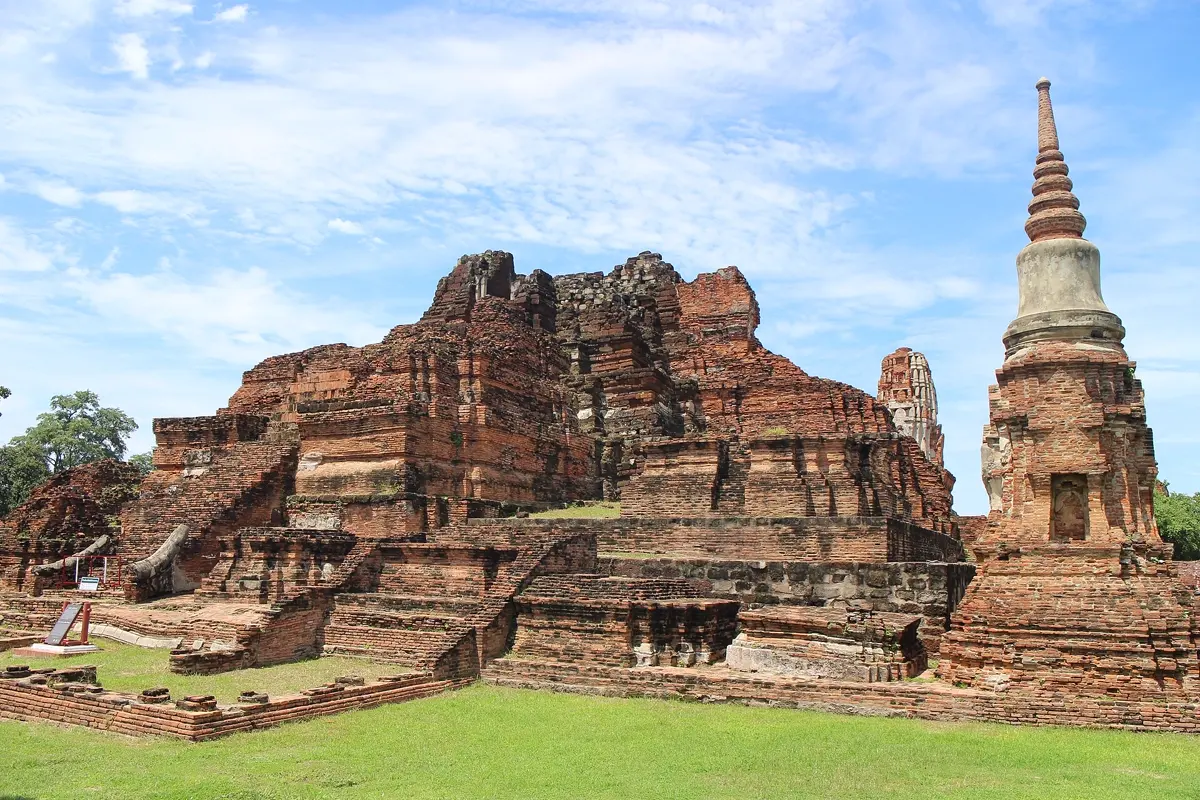
About 80 km north lies Ayutthaya, capital of the Kingdom of Siam until the 18th century and now a UNESCO World Heritage Site. The temple ruins are spread across an island in the river; the best known is the Buddha head wrapped in tree roots at Wat Mahathat. Ayutthaya is a day trip by train or car. Once there, hire a bicycle or a tuk-tuk for a few hours – the distances between the ruins are long on foot in the heat.
Days 5–8: Chiang Mai
From Bangkok to Chiang Mai is about an hour's flight. Slower but an experience in itself is the night train with sleeper berths – it also saves a night's accommodation. Chiang Mai is calmer than Bangkok, with an old town inside walls and a moat and more than a hundred temples. On the mountain above the city stands Wat Phra That Doi Suthep, with views across the valley.
From Chiang Mai, day trips into the mountains are worthwhile, for example to Doi Inthanon National Park with the country's highest peak, as are cooking classes and the night markets. If you want to see elephants, choose a sanctuary where there is no riding.
Day 9: Chiang Rai
About three hours north lies Chiang Rai. It is known for the White Temple, Wat Rong Khun, a modern work of art by a Thai artist, and for the Blue Temple. Many visit on a day trip from Chiang Mai; a night there and a flight to the beach the next day is more relaxed.




Days 10–14: Which beach – Andaman Sea or Gulf?
Thailand has two coasts with different weather. On the Andaman Sea in the west are Phuket, Krabi with Ao Nang and Railay, and the Phi Phi islands. Here it is driest from December to March; from May to November the south-west monsoon brings a lot of rain and often rough seas. In the Gulf of Thailand in the east are Koh Samui, Koh Phangan and Koh Tao. There the most rain falls from October to December, while February to August is comparatively dry.
The rule of thumb: travelling in the northern winter, go to the Andaman Sea. Travelling in summer, the Gulf is the better choice. Phuket to Krabi is 177 km, about 2:45 h of pure driving – the two combine well.
| Month | Phuket rain | Koh Samui rain | Chiang Mai rain |
|---|---|---|---|
| Jan | 76 mm | 132 mm | 25 mm |
| Feb | 29 mm | 47 mm | 21 mm |
| Mar | 52 mm | 38 mm | 10 mm |
| Apr | 105 mm | 106 mm | 57 mm |
| May | 214 mm | 108 mm | 183 mm |
| Jun | 195 mm | 77 mm | 224 mm |
| Jul | 198 mm | 98 mm | 333 mm |
| Aug | 214 mm | 80 mm | 387 mm |
| Sep | 254 mm | 145 mm | 330 mm |
| Oct | 269 mm | 221 mm | 173 mm |
| Nov | 239 mm | 288 mm | 48 mm |
| Dec | 133 mm | 224 mm | 25 mm |
Rain: monthly averages 2015–2024 from the ERA5 reanalysis (Open-Meteo), rounded. Values apply to a grid cell of about 25 km.
Bangkok: weather through the year
Bangkok is hot all year. The difference is the rain: little falls from November to March, the rainy season starts in May and peaks in September. April is the hottest month.
| Month | Day (avg. high) | Night (avg. low) | Rain |
|---|---|---|---|
| Jan | 31.1 °C | 22.0 °C | 24 mm |
| Feb | 32.2 °C | 23.3 °C | 30 mm |
| Mar | 33.3 °C | 25.8 °C | 46 mm |
| Apr | 34.2 °C | 26.8 °C | 83 mm |
| May | 33.6 °C | 26.8 °C | 158 mm |
| Jun | 32.6 °C | 26.1 °C | 146 mm |
| Jul | 31.6 °C | 25.7 °C | 195 mm |
| Aug | 31.5 °C | 25.5 °C | 188 mm |
| Sep | 31.0 °C | 25.1 °C | 292 mm |
| Oct | 30.8 °C | 24.4 °C | 240 mm |
| Nov | 31.3 °C | 23.7 °C | 71 mm |
| Dec | 31.0 °C | 22.1 °C | 19 mm |
Temperatures and rain: monthly averages 2015–2024 from the ERA5 reanalysis (Open-Meteo), rounded.
Best time for the trip
For the whole route – Bangkok, the north and the Andaman coast – December to February are the best months: Bangkok then gets only 19 to 30 mm of rain a month, Chiang Mai 21 to 25 mm, and nights in the north are pleasantly cool at 16 to 18 °C. In March and April it gets hot, in Chiang Mai 35.5 °C on average in April, and smoke from field burning often hangs over the north. May to October is the rainy season; the rain usually comes in short, heavy showers, the country is green and quieter – in these months choose the Gulf instead of the Andaman Sea.
How YesTrip helps with this trip
In YesTrip you set up the itinerary with all its stops – for Bangkok there is a ready-made city plan with temples, river and markets that you can adopt. For Chiang Mai, Chiang Rai and your beach the AI builds a day plan. The weather forecast covers your travel days, and the packing list remembers light clothes that cover up for the temples and the right plug adapter. Travelling with others, you share the trip and settle shared expenses. The map also works offline.
What to know before you go
- Entry: many nationalities, including UK and EU citizens, can enter Thailand for short tourist stays without applying for a visa in advance; your passport must be valid for at least six months. The rules have changed several times recently – check the current requirements on gov.uk or with your own government.
- Power: 220 volts. Sockets are mixed; European two-pin plugs often fit, UK plugs do not – pack an adapter.
- Temples: cover shoulders and knees, and take your shoes off before entering buildings.
- Mobile data: a travel eSIM is cheaper than roaming and helps with ride-hailing apps and maps.
Free
Plan your trip in 30 seconds.
Tell YesTrip where and when – the app plans day by day with real places on the map, shows the weather, splits costs with your travel companions and guides you to the next stop on the go.
Frequently asked questions
How many days do you need for a Thailand itinerary?
Two weeks are enough for Bangkok, Ayutthaya, Chiang Mai, Chiang Rai and four to five days at the beach. With three weeks you can add more islands, such as Koh Lanta or Koh Tao, or the mountain area around Pai in the north.
When is the best time to visit Thailand?
For the classic itinerary with a beach on the Andaman Sea, December to February is ideal: Bangkok gets only 19 to 30 mm of rain a month, and nights in the north are pleasantly cool. In summer, the Gulf of Thailand around Koh Samui is the better beach region.
When is the rainy season in Phuket and Koh Samui?
In Phuket and along the rest of the Andaman coast most rain falls from May to November, 269 mm on average in October. On Koh Samui in the Gulf the wettest period is October to December, with 288 mm in November. From February to August Koh Samui is comparatively dry.
How do you get from Bangkok to Chiang Mai?
Fastest is a flight of about one hour. Alternatively, a night train with sleeper berths saves you a night's accommodation. Long-distance buses also run but take much longer than flying.
Do I need a visa for Thailand?
UK and EU citizens do not need to apply for a visa in advance for short tourist stays. The entry rules have changed several times recently; check the current requirements on gov.uk or with your own government.
Sources
- Climate data: ERA5 reanalysis via Open-Meteo, monthly averages 2015–2024 – open-meteo.com
- Driving times: OSRM route calculation based on OpenStreetMap data – project-osrm.org
- Entry requirements for Thailand: UK Foreign Travel Advice – www.gov.uk
- Weather and monsoon in Thailand: Thai Meteorological Department – www.tmd.go.th
Researched with AI support and checked by our editors. Prices, opening hours and weather can change – please check before you go. YesTrip is not a travel agency. Published: .
More articles
 Road trips & itineraries
Iceland road trip itinerary: Ring Road in 12 days
The classic Iceland road trip follows the Ring Road for 12 days from Reykjavík: Golden Circle, the south coast with Skógafoss and Vík, the … · 8 min read Road trips & itineraries
Ireland road trip: a 10-day itinerary
The classic 10-day Ireland road trip runs from Dublin via Glendalough and Kilkenny to Cork and Kinsale, around the Ring of Kerry, to the … · 7 min read Road trips & itineraries
Japan itinerary: 2 weeks by train
The classic two-week Japan itinerary runs by train from Tokyo via Hakone near Mount Fuji to Kyoto, Nara, Osaka and Hiroshima with the island … · 7 min read


